
- advaita vedanta
- alignment
- anger
- answers
- backbends
- balance
- bandhas
- beginner's mind
- believe
- blood
- body
- breathe
- cardiovascular system
- cervical
- chakras
- chaos
- cleanse
- confidence
- creativity
- darkness
- digestive system
- dreams
- drinking water
- ego
- emotional health
- endocrine system
- energy
- escape
- essential oils
- eyes
- fear
- fire
- flexibility
- focus
- freedom
- gift
- grounding
- heart
- heart chakra
- humility
- injury
- inspiration
- intermediate series
- intuition
- joints
- lactic acid
- left-brain
- lessons
- letting go
- life-changing
- living yoga
- love
- lymphatic system
- meditation
- mental health
- mind
- muscles
- muscular system
- mysore
- nervous system
- nutrition
- obstacles
- oxygen
- pain
- path
- patience
- peace
- philosophy
- presence
- qi
- relaxation
- respiratory system
- right-brain
- sacred
- samskaras
- sankhya yoga
- sattva
- secrets
- self-confidence
- shadow
- shoulder opener
- silence
- skeletal system
- spine
- spirit
- sthira bhaga
- stillness
- strength
- stress
- surrender
- tapas
- time
- toxins
- true power
- ujjayi breath
- vata
- vinyasa flow
- vulnerability
- water
- words
On stress and hormone balance: Functional medicine approach

When the light shines through. © Image Robin Ellen Lucas
When the light comes through the shades in my yoga space, I know that I’m toward the end of my practice. It’s a good metaphor for my state of mind too, where light is the clarity and calm state of being.
Stress (with too much adrenaline and/or cortisol) can be a silent underlying cause of bigger problems with the mind, body and beyond.
If stress becomes chronic it can shut down feelings—the opposite of heart-opening, and it can negatively impact other hormones such as pregnenolone (a.k.a. “pregnenolone steal”) thereby shifting hormone balance creating more cortisol rather than DHEA, estrogen, testosterone, etc.
I am a Functional Medicine Certified Health Coach, specializing in guidance on root cause analysis, motivation, metabolism, nutrition, mitochondria, systems medicine, and more.
-robin
#functionalmedicine #stressrelief #adrenalhealth #hormonebalance #mentalhealth #peaceful #ashtangayoga
On inspiration and how it touches you

Inspiration comes in many forms.
We are inspired by nature, by animals, by other people, and the list goes on. Today I am inspired by all 3 including the birds (not just my cats) and by a fellow yogini for inspiring me to attempt a challenging yoga asana.
Just trying is half the battle—within your limits, of course.
feel your passions
It's a beautiful life when you feel passion and inspiration moving through you. Believe in yourself. It touches all you do.
Namaste.
~ Robin Ellen Lucas, MA

Face yourself each day, rain or shine
My daily ashtanga yoga practice allows me to feel what it means to face myself each day, rain or shine.
I've always loved backbends. They feel euphoric. I don't hold tension in my lower or mid back.
discover where you hold tension
However, I have recently discovered the reason why some backbends bring up a lot of emotion for me and others not. I hold my tension in my shoulders. Certain weight-bearing positions on my shoulders causes a bit of what I hold to seep out, along with emotions as this occurs (or within the hour).
The shoulders are an extension of the Heart Chakra (Anahata Chakra). But, asanas with a really deep shoulder rotation first, such as this one (Natarajasana B) free that energy completely—or so it seems—because I am not only feeling the euphoria of a backbend but my shoulders are unlocked!
free yourself
Here in this state, I feel serious personal power and like nothing could ever harm me.
Namaste.
~ Robin Ellen Lucas, MA
The key to making your mind stable
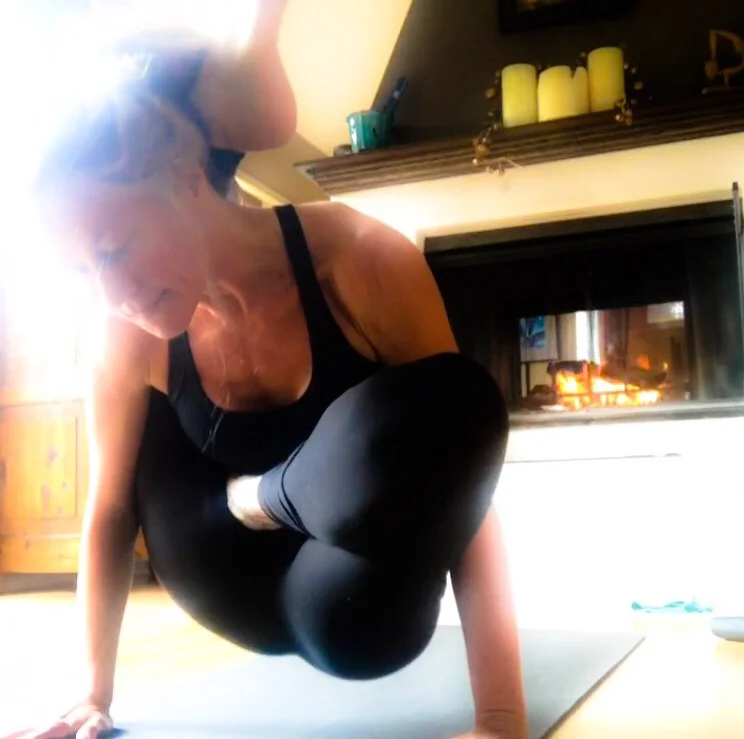
Yoga is not performance. Asanas are known to make your mind very stable, and that’s why I do them, along with the profound after effects and how these effects trickle into life as a whole.
Each person is different (mind, history, physical skeletal structure, lifestyle, heart and soul); I don't believe that there is just one way to do a yoga pose to be "correct". There is more to it.
on the other side of challenge
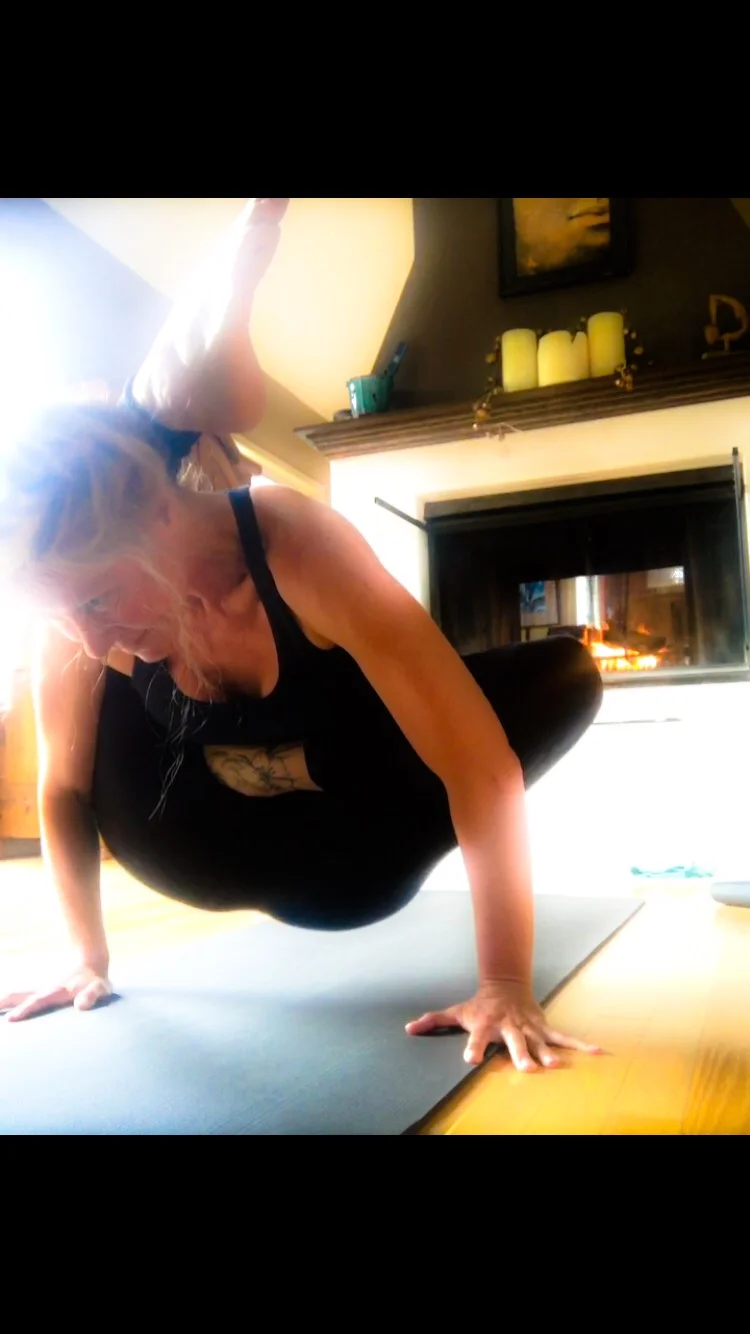
© image Robin Ellen Lucas
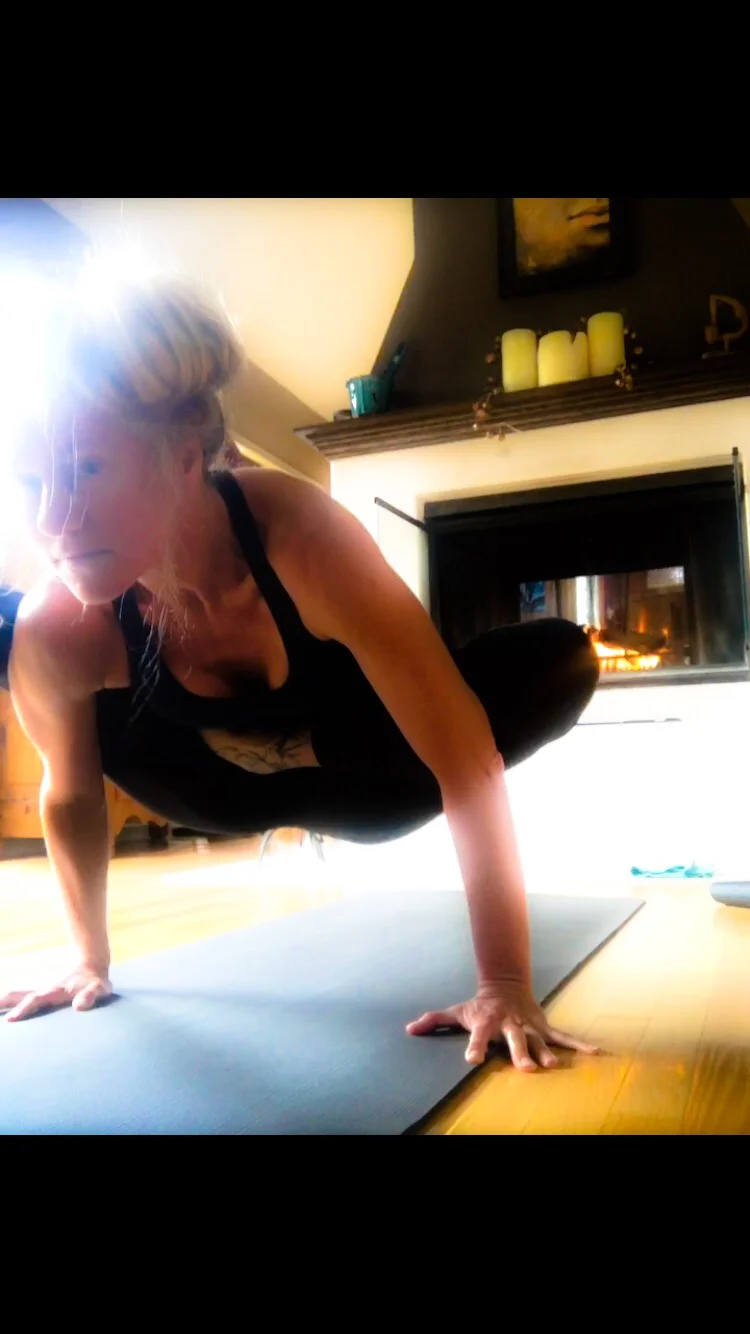
© image Robin Ellen Lucas
This pose, Viranchyasana A (the third part of it) in the Ashtanga 3rd series (Advanced A) has a lot more going on than performance in the moment. It's a challenge.
It's not that I enjoy struggle. For me it's what's hidden on the other side of challenge, and how that pursuit translates into life on many levels.
It's taken me over 20 years to have the flexibility and strength and trust to even try this asana, and mostly to get my mind out of the way.
look inside yourself
The benefits are in the nervous system, the somatic subtle body, the ego, emotions, hormones, etc. (I could keep adding to that list all day). I am looking inside my own self here, and it's a very calm and beautiful place.
Namaste.
~ Robin Ellen Lucas, MA
Enter into a devotional relationship with your yoga practice
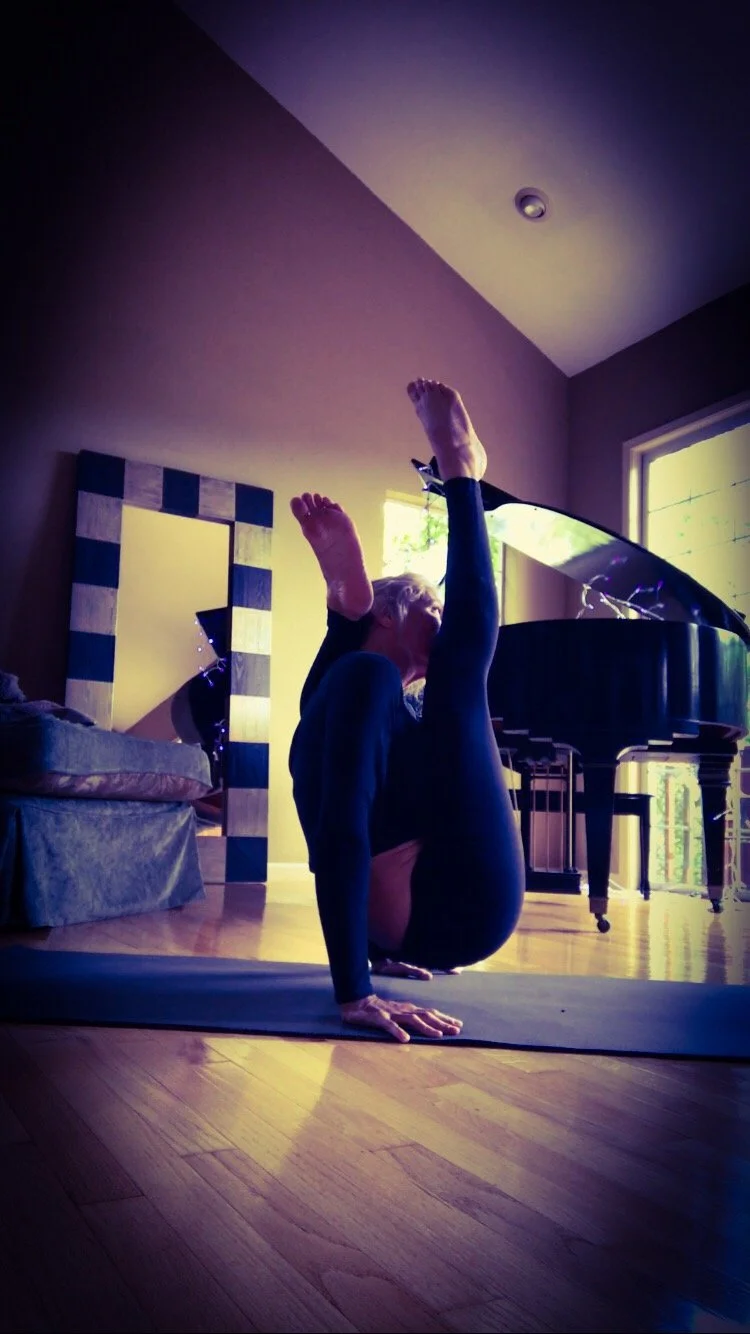
Chakorasana is an asana in the Ashtanga Third Series (Sthira Bhaga) and also an exit for some of the poses in Third and also Second series.
Some words about Third Series from Kino Macgregor (paraphrased), "It is a devotional practice that burns through some of the deepest blockages that exist in the human mind and body. The true lesson comes when you move through that initial phase into a daily devotional relationship with the practice (i.e., when you feel good, when you feel just ok and also when you feel bad)."
burn out blockages
I do this asana approximately 27 times per week, both sides.
It burns out subtle blockages in the hips, strengthens arms, frees the neck and strengthens the core (bandhas). For me it's also a chance to work on my very tightest body part, my shoulders; it's a reminder to push them back in order to free my neck while keeping the strength to lift—a continual lesson for me in becoming flexible by doing it over and over again for years (and smiling at even the smallest amount of progress in my shoulder flexibility).
Most importantly, when the channels within me are open, my mind and body feel free, resulting in physical health, happiness and mental clarity.
Namaste.
~ Robin Ellen Lucas, MA
Calming your mind and shattering illusion

This pose is Tittibhasana A. It's in the Ashtanga Intermediate series (Nadi Shodhana). Each yoga asana has an ancient story behind it.
Tittibha = a little bird living along the sea. A story of the tittibha birds can be used as a symbol of yoga, where the birds lay their eggs, live peacefully, and the sea swallows them up; but, the sea gives them back when commanded to do so.
power of illusion
The sea with its might and power represents the power of illusion, ignorance and prejudice (i.e., citta - all aspect of human existence subject to change).
The small tittibha bird stands for the effort of the yogi, an effort which seems ineffectual when compared with the challenge.
calm the mind through practice
But just as the little tittibha bird succeeds, the yogi can calm citta through practice and shatter illusion. (Story from the Panchatantra).
Namaste.
~ Robin Ellen Lucas, MA
Drop your usual excuses: Rewiring your mental patterns
The one place where my tailbone feels comfortable in this asana (Navasana): at the beach. Now to bring a bag of beach sand with me to yoga class.
Why do this pose? It's a good way for me to describe what ashtanga yoga does for me.
breathe into challenge
On a yoga mat on hardwood floor, all of my focus is on slow deep breaths and on engaging uddiyana bandha and mula bandha. Going to the edge of challenge and breathing into it cultivates this pattern in other areas of my life.
When I first walked into a mysore-style ashtanga class and was asked to do this, I had all the excuses on why I'm not so good at it (One, I had 3 pregnancies and my abdominal muscles split apart; two, I fractured my tailbone). All of this was ten+ years before but I carried that excuse with me.
transform excuses to power
What I was really doing was coming up with an excuse to hide and not grow into being more than I was. Good metaphor for why I have continued with Ashtanga yoga. It has only gotten better (the lessons) since then.
Namaste.
Robin Ellen Lucas, MA
Float tanking for true relaxation and soothing muscle fatigue

floating, soothing muscles, improving toxin release, healthy immune system
thoughts before floating
I heard about this nearby Float Tank last night. Already I have an appointment. I'm all for complete relaxation, increasing the levels of dopamine and endorphins in my brain and reducing stress (and zapping the dreaded Cortisol). All of this leads to greater well-being. I'm sure I'll sleep well tonight!
Why float? I love swimming in water, especially floating in the warm ocean. I grew up in Florida and floated most of my childhood in the ocean or my pool. This cooler time of year draws me to my hot tub each evening. But the water is not buoyant. Sounds like true bliss to float with music, dim lights and a completely private and surreal setting. It may be like amniotic fluid.
The float tank is filled with epsom salt (magnesium). I'm a big fan of epsom salt baths because it soothes my aching muscles from yoga. Why does magnesium help?
Here's how it works. Building muscle causes fatigue. Healthy muscles (called "red muscles”) have a reserve oxygen supply, permitting them to contract and relax repeatedly while maintaining cellular respiration which resists muscle fatigue. The myosin protein in muscles causes contraction and relaxation acting as enzymes, which break down ATP molecules (adenosine triphosphate). ATP provides energy so we want to keep an ample supply in our muscles. When ATP is used up too quickly without the oxygen to support it, muscles (called "white muscles") become quickly fatigued with the build-up of lactic acid—an indication that muscle cell oxygen has been depleted.
Magnesium in epsom salts helps by flushing lactic acid build-up in the muscles. Magnesium is an abundant mineral in our bodies and its role in our overall health is important. It can be found in over 300 different enzymes in our body and is vital for activating muscles and nerves, creating energy in the body and efficiently digesting proteins, carbohydrates and fats. Other ways to replenish magnesium are eating organic foods, lowering sugar intake and lowering stress.
(Read more here from my healing series on muscle fatigue)
about the float tank
I went to Float North County. The water is 93.5 degrees and filled with 1,100 pounds of epsom salt which means you float effortlessly. People float to relieve stress, recover from injuries, fight addiction, eliminate chronic pain, etc.
It is said that after 30-45 minutes of floating, your mind starts producing theta brainwaves, which are responsible for that state between waking and sleeping.
reflections after floating
At first I wondered how I'd keep myself company for 90 minutes. I wasn't tired. I began by playing with the lighting and moving around, bouncing lightly off the walls. I found it difficult to relax the back of my neck at first even though I completely trusted that I didn't need to hold it up. The water was only like 1-2 feet deep. The attendant told me that I don't want to get the epsom salt in my eyes, but that wasn't making me tense as I had my towel nearby.
I realized in there that you are faced with yourself, but in a different way than a yoga practice where you get to move the energy around. I felt the tension that I carry around with me in the world. It was highlighted as I put all of my focus on it. Coincidentally, the back of my neck is my latest tense spot in my yoga practice that is holding me back so it's my new focus. Who knew I'd end up in this float tank to fulfill my destiny...
I began to do pranayama breathing—the simple 1:4:2 ratio through my nose. I could hear my breathing. It was soothing. I did this for about 30 minutes. I watched my reflection on the ceiling which was very faint but clear enough. Eventually I felt the need to do some yoga-like poses from side to side, feel some bones crack, etc. Felt great.
I flipped my body around to the other side and was then noticing my hair flowing in the blue light. The next thing I knew I was making mermaid shapes on the ceiling, different swaying motions to see which hairdo I could make in my reflection.
Next time I checked in with myself I realized the tension in the back of my neck was gone. Everything was in slow motion. I was like a blue avatar (from the movie Avatar) floating in the tank. My fingers seemed really long. I could see them on the ceiling. I spent about 5 minutes moving them slowly, checking them out. I was almost motionless.
At this point I realized that I was distracted. I was entertaining myself. I wanted to try to be extra still. I knew I needed to grab my phone for a photo first. I'd relax better after that...
It wasn't until later that I turned the lights out so that it was completely dark. When I tried this at the beginning I didn't like it. The music was only playing for the first 8 minutes. In the dark I stopped breathing through my nose as if I were in a yoga class trying to stay present. I breathed through my mouth. I wasn't sleeping but I was in heaven.
I finally knew what it was like to completely relax while floating. I didn't want the moment to end.
I'll be back and expand upon my journey.
reactions next day
I woke with a headache. I've known epsom salt baths to be detoxifying, but this concentrated amount and for a long period of time really amplified the process.
Magnesium increases circulatory functions, improving toxin release. Today I will using my juicer often to flush the toxins that are being released, replenish with good electrolytes and minerals, assisting my immune system, hormones and more! I'll start with celery, cucumber, cilantro, lemon, microgreens. And a shot of apple cider vinegar.
My skin feels awesome! I was surprisingly awake later than normal last night, feeling vibrant, but had a deep sleep. I remembered very detailed dreams.
Namaste,
-Robin Ellen Lucas, MA
In my blood: Cardiovascular system, the heart and its many facets
 Koundinyasana B (Image © Robin Ellen Lucas)
In a song that keeps playing today, I hear my blood. It speaks of being inside my blood. From my yoga Healing Series on Cardiovascular System—combing through various anatomical systems, presenting the physiological, emotional, spiritual and yoga aspects—I am reminded that this was my favorite section. It was the last one; I saved the best for last, as the cliché goes.
It's all about the heart. Blood and plasma, protection from disease, effects of oxygenating the blood, emotional and subtle heart, unresolved traumas, yoga and the venous return to the heart, blood as a healing entity, blood circulation affecting the nervous system, traditional chinese medicine perspectives, somatic levels of changes, etc.
Back to the song:
"Every time I close my eyes I know that I'll wake up."
We know that we'll wake up again each morning because our blood is flowing.
"I don't know how it happened, but you got into my blood. And I feel like you're lifting me up. Was it real or did I just make it up?"
It's real.
Read more here -> /cardiovascular-system/
Namaste.
Robin Ellen Lucas, M.A.
Ayurveda and Ashtanga Yoga: Balance and the Ego
 Image © Robin Ellen Lucas
the study of inner space
Ayurveda is the sister science of Yoga. Mysore-style Ashtanga yoga is based on the principles of Ayurveda, since it is customized for each person. It is the study of the inner space within you and so too is a self-led Ashtanga practice where you listen to your inner voice.
The main goal of both Ayurveda and Ashtanga Vinyasa Yoga (Mysore-style self-led practice) is to bring yourself to a balanced state. Each individual is unique, leading to varying definitions of what it takes to come into balance.
Image © Robin Ellen Lucas
the study of inner space
Ayurveda is the sister science of Yoga. Mysore-style Ashtanga yoga is based on the principles of Ayurveda, since it is customized for each person. It is the study of the inner space within you and so too is a self-led Ashtanga practice where you listen to your inner voice.
The main goal of both Ayurveda and Ashtanga Vinyasa Yoga (Mysore-style self-led practice) is to bring yourself to a balanced state. Each individual is unique, leading to varying definitions of what it takes to come into balance.
you are born with your own nature
You are who you are. You're born with it. In Ayurveda, you have a mixture of 3 of the doshas (Pitta, Vata, Kapha) and what you are, you are. You can't change it; you can only be aware of what triggers imbalances in you and learn the best lifestyle.
Pitta is the fire, Vata is the air and Kapha is the juice.
Lifestyle matters
Just as Vata, Pitta, and Kapha each guide you on an innate level depending on your nature (i.e., constitution), Ojas, Tejas and Prana rise and fall depending on lifestyle, activity, diet, etc. Ojas, essential internal juices, are vital for grounding Ashtanga yoga practitioners (Kapha). Tejas allow transformation, built up using your fire through asanas, but too much burns up Ojas (Pitta). Prana is the subtle life force found in your own breath (Vata).
Tame the ego
What we want to do is get in touch with our true self and live from that place. A quote from my Healing Series on psychological ego and spiritual ego:
"The psychological Ego needs to perform and be judged. With continual Ashtanga practice, this ego melts. The spiritual Ego carries the misinterpreted reflections of the mind when it is not clear and peaceful (Advaita Vedanta)." (Breaking down the Ego, my Healing Series)
In summary, honor your inner fire, your muscles, your breath. Use your bandhas (internal locks). Develop courage (feel fear and do it anyway). Remember who you are...
Namaste.
~ Robin Ellen Lucas, M.A.
Digestion and emotions: Which brain do you use?
 Galavasana (Image © Robin Ellen Lucas)Digestion and emotions are connected. The belly holds a lot of power. The power center is accessed by activating mula bandha and uddiyana bandha.
The vagus nerve connects digestive system / enteric nervous system in the gut to the central nervous system. Read more here about the digestive system and its anatomy. It's important to have optimal digestion to practice Ashtanga yoga, but also in life as its dysfunction can cause a ricochet effort on other anatomical systems and optimal subtle body health.
what you cannot see
Having said that, in this pose, Galavasana,
Galavasana (Image © Robin Ellen Lucas)Digestion and emotions are connected. The belly holds a lot of power. The power center is accessed by activating mula bandha and uddiyana bandha.
The vagus nerve connects digestive system / enteric nervous system in the gut to the central nervous system. Read more here about the digestive system and its anatomy. It's important to have optimal digestion to practice Ashtanga yoga, but also in life as its dysfunction can cause a ricochet effort on other anatomical systems and optimal subtle body health.
what you cannot see
Having said that, in this pose, Galavasana, I'm not just holding myself up with my abdominal muscles. First, of course, the bones are stacked correctly and arm and leg muscles activated. Most importantly here, however, is what you cannot see in the photo. I'm activating the bandhas (internal locks in pelvic region), my mind is clear, my body is well rested (I go to sleep by 9:00 p.m. each night), my diet is clean, I am an essential oils junkie advocate which is a lifestyle, et al.
It's what's inside me. There is a personal power activated within my mind having performed this pose each morning as part of my Ashtanga practice.
"mind is going"
One point that comes to mind is that I am often exhausted at this stage in my Ashtanga practice, yet the pose happens. It's a great example of my mind-body working from the subtle body to find energy, strength and memory. My teacher, Tim Miller, says to me "mind is going" in a humorous tone when I forget where I am a couple hours into my practice—guided from a spiritual place. Even so, my practice happens. It's on auto-pilot.
"Do your practice and all is coming," by Pattahbi Jois, is a phrase that sets Ashtanga yoga aside from other yoga styles. The body goes on auto-pilot and teaches its lessons from there. After the initial lesson(s) from the teacher, there is often no one to instruct or explain what to do, when, or how—only helpful adjustments in silence—which allows the dedicated practice to be the teacher.
your inner voice teaches
Ashtanga yoga is about listening to your inner voice. Over time, your practice is your teacher. I resonate with this on a subtle body level, having done led Iyengar and mixed-style/level Vinyasa classes for 18 years prior to trying Mysore-style Ashtanga yoga. My inner voice is the reason I have completely switched over. It gives me the chance to hear, to heal, to go to the next level (physically, emotionally, spiritually).
It reminds me to use my bandhas and take full breaths continuously because I know in my heart that my core/lower abdomen/pelvic region (from the inside to the outside) is my power source! This holds true for my entire life, not just yoga poses.
From my experience, teachers of led yoga classes often guide by requesting skeletal alignment and muscular engagement because that is what they can see in their students. They may cue the importance of using your bandhas and trusting in yourself, but in a sense, it's truly only part of their verbiage—despite their intellect and experience, not necessarily what you, the student, are going through in that very moment.
Ashtanga yoga reveals
I have some of the hidden answers in my body. They reveal themselves when I do the poses over and over and over, with patience and perseverance (and no attachment to the end results since each day can be different). For me, the blocks—physical, emotional, spiritual—are released in the subtle body. No teacher is telling me about that; I am.
It is my thought that restrictions by a teacher create rigidity in the students' minds and bodies, which is the opposite of the freedom we wish to create in our yoga practice.
That's a vague statement if you delve into it both intellectually or experientially within your own yoga practice. Sometimes, these notions can be referred to as coming from different parts of ourselves, as if we have more than one brain in our bodies. I understand this concept directly through my study of essential oils.
essential oils and different "brains"
There is, of course, a brain in your head and central nervous system. Frankincense essential oil activates the spiritual, supporting your ultimate brain functioning. It's known to oxygenate the Pituitary gland, which is the master gland that controls the release of hormones from other glands. It’s vital to our well-being and also connects to the Hypothalamus (nervous system), harmonizing them together. Yoga also accentuates this balance.
Along these lines, there is another "brain" in your gut and enteric nervous system / digestive system. Circling back to the initial point in this article—digestion and emotions—as I discussed in my Healing Series, there is a lot more going on in your belly than abdominal muscles. Our guts (literally) are in the area that has been medically proven to be a second brain, the enteric nervous system. Including neurons, neurotransmitters, hormones, your gut is able to learn, remember and produce emotion-based feelings. The two nervous systems are connected through the vagus nerve. (Source: from my Healing Series)
Fennel essential oil helps digestive functions act on their own, in particular ridding the body of the toxins that hold you back. It is also said to restore strength and courage, going back to ancient Egypt.
Finally, I can identify with another "brain" in the feet and sense of self. This is essentially in the first chakra in the subtle body but also the emotional body. Myrrh essential oil is an earthy essential oil which grounds the nervous system. The bottoms of the feet are an ideal place for the oil—like walking in the dirt or grass.
Tend to your digestion and emotions... For more of my writing on essential oils, go over to that blog.
Namaste.
~ Robin Ellen Lucas, M.A.
How essential oils have enhanced my Ashtanga yoga practice and life
 Image © Robin Ellen Lucas
why essential oils and ashtanga yoga?
When I first started to experiment with essential oils, I thought of their scent which brought to mind the emotional sparks that would be kindled within me. I began with the more well-known oils mixed in with my bubble bath. Lavender, Patchouli, Sandalwood, to name a few... When I was going through a challenging time, a friend insisted that I put some Frankincense on the bottoms of my feet and top of my head. I did as instructed and I didn't know why. I trusted.
Fast forward to years later... I now am quite the essential oils investigator extraordinaire. After stumbling upon a close friend's website while I was buying some of her artwork, my intuition clicked on the "essential oils" tab to dive into this deeper. What else was there to know? Why was I drawn to these little brown bottles of elixir and how could they shape my holistic health practices?
Image © Robin Ellen Lucas
why essential oils and ashtanga yoga?
When I first started to experiment with essential oils, I thought of their scent which brought to mind the emotional sparks that would be kindled within me. I began with the more well-known oils mixed in with my bubble bath. Lavender, Patchouli, Sandalwood, to name a few... When I was going through a challenging time, a friend insisted that I put some Frankincense on the bottoms of my feet and top of my head. I did as instructed and I didn't know why. I trusted.
Fast forward to years later... I now am quite the essential oils investigator extraordinaire. After stumbling upon a close friend's website while I was buying some of her artwork, my intuition clicked on the "essential oils" tab to dive into this deeper. What else was there to know? Why was I drawn to these little brown bottles of elixir and how could they shape my holistic health practices?
concentrated medicinal elixirs
I got as much information as I could, including the real deal on quality, a company that believes in co-impact sourcing so that workers worldwide get paid adequately, certified pure therapeutic grade (CPTG), and most of all the health benefits when these medicinal essential oils are used orally, topically and/or diffused through the air.
Over time I learned how potent one drop can be, and how each oil is, in fact, a concentrated medicine. I ached to learn more. I found a way to get wholesale prices and lots and lots of freebies so that I could try as many as I could; this led to wanting to try them all!
close to the heart
I began my introspections within my Ashtanga yoga practice, the place I hold dearest to my heart. I am most present here to myself, so this was the best place to determine each of the oils' authenticity, effects on my emotions, spirit, body, mind and heart. These reasons, after all, are why I practice Ashtanga yoga in the first place.
I started with the aromic scents found in the delicately balanced doTERRA blends. I cried, laughed, strengthened and felt their powers. I took this empowerment into my days, diffusing oils and wearing them at my computer in my home office—where no one could catch a drift of my scent or watch me with my newfound obsession passion. I learned about their powers with emotions, spirituality, creativity, physical soothing, skincare, etc. The more I learned, the more I wanted to learn.
I'm completely convinced now. I'm an aficionado, devotee, fanatic, enthusiast.
If you're interested in learning more about my essential oils journey, go over to my essential oils blog.
Namaste.
~ Robin Ellen Lucas, M.A.
Are you nervous? Ashtanga yoga cleanses the nervous system
 Bow to who you are becoming... (Balasana, image © Yoga Robin®)Are you nervous? Many people do yoga to increase strength and flexibility, to lower stress and to gain mental and spiritual clarity. Those are great reasons. After a yoga practice, no matter which style (e.g., Ashtanga, Iyengar, etc.) you'll undoubtedly be left with an overall feeling of peacefulness that tops the way you felt before you moved your body.
uplift mood, lower stress
Physical exercise in general helps to uplift the mood and lower stress levels; in particular, it diminishes Cortisol, the stress hormone. Ashtanga yoga has an added benefit: nervous system cleansing.
This is especially true in the Ashtanga Intermediate Series, Nadi Shodhana (2nd series), and that is its main purpose. This goes back over 5,000 years. When practiced regularly (5-6 days per week), the "cleansing" of the nervous system can be felt in various ways and many are *not* enjoyable.
nervous system cleanse kicks your ass
It wasn't until after practicing Mysore-style Ashtanga six mornings per week (specifically, half of the Primary Series, full intermediate, and beginning of advance A—takes 2-2 1/2 hours) for approximately nine months that I was able to discuss the nervous system cleanse in a positive light. That is putting it lightly.
It can feel like overall fatigue. All. Day. Long. It can feel like anxiety, over-sensitivity to lights and sounds, depression, obsession, needs to be in solitude, drinking more wine, yet a pervading fearlessness that overrides it all... It can feel overly emotional. It can take over your life and force you to make some big lifestyle changes, like adding an afternoon nap, going to sleep earlier, eating more protein, taking more epsom baths, wondering what is wrong with your life, questioning love, feeling safest while hanging out with your cats, etc. But why do it if it causes so much upheaval to the system?
because it works
Because it works... I like to see the nervous system cleansing as I would any other type of cleanse where you're taking away habits that may be contributing to harm in your body. Whether this be detoxing from sugar, caffeine, or all food in general to clear out the intestines, a cleanse does not necessarily feel good while you're in the process of it. The idea is to rid your body of toxins; on their way out, you feel them full force as they rise to the surface, so to speak.
This is all a great way for me to understand the nervous system cleanses. I was feeling toxins in my nervous system and I was boldly letting them play themselves out, knowing that if they didn't, they would continue to control me from underneath it all. In this case, they were involuntary processes driving me, also affecting me physiologically, and were of a higher intelligence in the mind-body.
It all makes sense. The nervous system directs complex processes (seeing, hearing, tasting, feeling, responding). It regulates the internal environment and links to external environment. It directs the organs in the body so that they don’t act independently of each other; without a nervous system, there’d be chaos inside.
wants to feel that again
When the autonomic nervous system's sympathetic is out of balance, and escalated (fight-or-flight), your body reacts as if it needs to protect itself... your heart beats faster, your body temperature increases, you feel anxious, you feel like a victim, you are triggered by even small incidences (as your nervous system remembers and wants to feel *that* again).
I describe this as an electric feeling that will *not* go away no matter what I do to try to soothe it. It was probably even accompanied by a scared look on my face—or in my aura—that even animals would stay away from me.
Calming this side down illuminates the parasympathetic, bringing calm to your body, heart and soul. Here you can breathe calmly again and the electrical impulses are replaced with a softly-flowing river of prana, bathing you with each breath. Your muscles relax, your mind stops overthinking, you actually are relaxed.
I believe that the nervous system is smarter than the mind. Yet, its direct connection to the mind dissolves the protective boundary as it's easily triggered, vulnerable to the mind's overthinking and worry. A main purpose of yoga in general is complete cessation of the mind, as the thinking mind is what creates suffering.
i've been rewired
I'm different now. Subtleties such as no longer becoming easily startled by spontaneous sounds make me smile when I notice this new involuntary response of calm. The biggest change is an overall lack of emotional triggers that have historically affected me deeply, physically but also unconsciously; those natural responses—harmful ones—have dissolved. That's my reason in a nutshell for waking up each morning at 5:00 a.m. to return again to my mat.
Now I'm able to go to the next level, which used to be more of an act of will power or something that only worked for other people. The best way to feel your spirit and know—without a doubt—your next move in life is to first get STILL. This means, calming the nervous system first so that you can see the magic. Ashtanga Yoga works for me and essential oils are a big help too (next topic :)
Namaste.
~ Robin Ellen Lucas, MA
Shoulder opening and alignment is key in balancing postures
 Image © Yoga Robin® (Scorpion)Using my new favorite yoga toy, the "Infinity strap" to keep my shoulders from flailing out too much (a little stretchy).
Arms should be parallel to each other. My shoulder rotation makes this a tough one. Also, in order to get my feet to my head, my cervical spine and lumbar spine both need to bend more. Balancing is easier on this pose with the head and feet offering the balancing weights.
Pincha Mayurasana is more challenging for me.
For both poses, shoulder alignment is important but for Pincha Mayurasana it's the foundation to also aligning the hips over the shoulders, tucking the rib cage in (not sticking out), which in turn elongates the legs upward. Then balancing is simple and comfortable (no nerve pinching in shoulders).
Of course, shoulder muscles are activated as these are strength poses, but if the bones are not aligned correctly, the right muscles are not able to fire, giving room for other muscles to overcompensate. This causes injury (especially with repetition), in particular to the rotator cuff—subscapularis, supraspinatus.
Namaste.
~ Robin Ellen Lucas, MA
 Image © Yoga Robin® (Pincha Mayurasana)
Find your strength by uncovering fear
 Galavasana (Image © Yoga Robin®)When you're trying to find the strength, sometimes it can be found in what would seem to be indirect places.
Expressing emotions unlocks secrets. Voices speak from within the subtle body. What you hear might not be easy to deal with, but move your body around anyway and hear it. Unclog your heart.
Don't build a shell around you or act out from that hidden source covered with fear. Embrace uncertainty.
Namaste.
~ Robin Ellen Lucas, MA
Deep twists wring out toxins
 Dragonfly (Image © Yoga Robin®)This deep twist helps to wring out toxins. It also helps to give myself a beneficial self-chiropractic adjustment to my entire back, shoulders, hips, and more.
I often thank my Ashtanga yoga practice for the gifts it's given me. This yoga pose isn't quite part of my Ashtanga practice (and probably never will be as the full pose is in the 4th series, which I don't believe is in my grasp.) In the full pose, the bent leg is behind the head rather than balancing on the back of the tricep on the arm.
Thank you. I love doing this pose whenever I can, outside of my Ashtanga yoga practice. (Dragonfly, Parsva Bhuja Dandasana—a variation).
Namaste.
~ Robin Ellen Lucas, MA
Calm the nervous system with this yoga pose
 Halasana (Image © Yoga Robin®)
Perfect pose for a rainy day. Calming to the nervous system while stimulating abdominal organs and thyroid. It feels great on spine and back. The spine elongated, ligaments stretch.
I love this pose and could remain here for a long time. (Halasana pose).
I always follow this one by bending my knees around ears for an extended relaxation. (Karna Pidasana pose).
It's a great pose for winding down or for destressing. It happens to be part of the Ashtanga Yoga closing sequence.
Sitting in a chair all day is bad for you
 Ardha Matsyendrasana (Image © Yoga Robin®)
Don't sit at desk all day
It's important to take a break while working at your desk. Sitting in a chair all day is not good for you. Even for a few hours it takes a toll on your cervical, thoracic and lumbar spine. It leads to muscle degeneration, organ damage, lymphatic blockage, psoas contraction, circulatory issues in legs, etc. I personally add psychological craziness to the list.
I do quick yoga breaks often in my office, in particular to keep my spine elongated and shoulders open. I practice Ashtanga yoga every morning so it's a matter of reopening what was already open earlier in the day. If I let all of my hard work succumb to the computer, I feel a combination of carpal tunnel syndrome and skeletal misalignment in my upper back.
Getting into alignment in my yoga practice each morning is such a precious thing! Keeping it is my daily at-home or at-office practice.
Namaste.
Backbends are a sure thing for unleashing prana
 Natarajasana B (Image © Yoga Robin®)This pose feels so good with the strap. The Ashtanga way is to hold the toes, no strap (and for me, this means that all of my energy goes toward not dropping the foot, or even getting it). My favorite Iyengar teacher instructs this one with a strap.
It is a wonderful shoulder opener (euphoric) and doing it this way I'm feeling the Prana in my shoulders, entire back, up and down legs. I'm even smiling. Using resistance against the strap (foot and shoulders higher up) feels even better. I forget I'm even balancing. My favorite backbend...
Backbends are a sure thing for unleashing all kinds of emotional holding. For me, it's a guarantee and always leaves me happier. Some people experience fear and sadness in backbends (and I'm also one of them) as these feelings hide inside a broken heart or cold heart that doesn't feel much...but can't help but rise to the surface in backbends. Getting the energy to express itself is a wonderful way to release it.
Namaste.
 Eka Pada Rajakapotasana (Image © Yoga Robin®)
Pursing a graduate degree: my process
 a celebration, an offeringMy Master of Arts degree?
The hardest question to answer about my Master’s Degree is, “So, what are you going to do with your degree?” It's as if I’m a nomad until I can answer this with precision. However, I have been utilizing my degree all along—for the past seven years as a part-time student—one semester and one class at a time. When I began in August 2008 I was already teaching yoga and I already owned my own business as a writer and digital marketer.
What turned into seven years of one class per semester in East-West Psychology turned into the best type of graduate experience I could have ever imagined. It was, in some ways, like self-led psychotherapy as I put my entire life into each one class, especially the final papers. Each semester I evaluated where I was at in life and it was always changing. I evolved at my own pace and could not imagine seven years ago being where I am now.
What I intend to do with my degree and with my professional life is to enhance it with the knowledge, credentials and confidence I've gained, which will bridge into my writing and yoga teaching. I'll go beyond private yoga lessons and posting my written version of passions on the internet as I've become accustomed.
My Master of Arts degree?
The hardest question to answer about my Master’s Degree is, “So, what are you going to do with your degree?” It's as if I’m a nomad until I can answer this with precision. However, I have been utilizing my degree all along—for the past seven years as a student—one semester and one class at a time. When I began in August 2008, I was already teaching yoga and I already owned my own business as a writer and digital marketer.
What turned into seven years of one class per semester in East-West Psychology turned into the best type of graduate experience I could have ever imagined. It was, in some ways, like self-led psychotherapy as I put my entire life into each one class, especially the final papers. Each semester I evaluated where I was at in life and it was always changing. I evolved at my own pace and could not imagine seven years ago being where I am now.
What I intend to do with my degree and with my professional life is to enhance it with the knowledge, credentials and confidence I've gained, which will bridge into my writing and yoga teaching. I'll go beyond private yoga lessons and posting my written version of passions on the internet as I've become accustomed.
I’d like to write for my clients on mind-body awareness and healing, psychology and yoga. I can imagine complementing western medicine practitioners who are open to alternative medicine and wellness, desperately needing my knowledge infiltrated into their own. I’ll be a Health & Wellness Coach. I’d like to publish my work in various mediums. What began as a crusade for self-improvement (i.e., M.A.) turned into a pursuit of honing in on my natural skills as a career path.
My natural skills tell me to be creative. As I prepare two of my papers for publication, I write in various creative realms to get in the mood for this effort. This seems ironic because academic writing is left brain analytical, whereas my life planning comes from the right brain.
Resistance to who I am
It's hard to imagine that I am all of a sudden more than I've ever been. I resist having to start over with a new hat, that although I believe is important, has evolved over seven years to such an extent that it’s not my current plan to drastically start something new. I can only be who I am—what I’ve been becoming—and this means that I've needed to acclimate slowly. I use my instincts.
I don’t want to be who I’m not, who others are. I don’t want to be pressured by projected goals and beelines for greatness. I am me. I have faith that these words alone will guide me.
I feel unique and personally powerful. But also, I feel misunderstood. I don’t know exactly how to phrase my new role in the professional world.
My perception of others' views—mockery or anger at what my revelations will do to them personally—holds me back. I know issues that people escape, preferring to portray a life of freedom and fun, or complaints and hopeless snideness. Its core is anger. It's been my own anger. I sometimes feel a strong sense that a person I care for deeply is angry at me, after I eloquently questioned with a full open heart. But the universe reminds me of the true meaning of anger.
David Whyte articulates what I mean:
"Anger is the deepest form of care for another... and for all our ideals, all vulnerable and all possibly about to be hurt. Stripped of physical imprisonment, anger points toward the purest form of compassion, always illuminates what we belong to, what we wish to protect, and what we are willing to hazard ourselves for."
I am meant to have freedom to create
I am meant to help multiple people and companies as an independent contractor. I also know who I am—through living life, through graduate school, through my personal yoga practice—and it speaks its voice as loud as can be now. It tells me about my freedom to create in the moments that inspire me, as my own driver in my life and career. My life structure invites morning ritual and health, followed by an unknown open space which lures me to create. In this space, working for myself out of my own home—visiting clients when it makes sense—is the best vision.
I want to share my formulated words and teachings in publications, both online and in print. This accumulated knowledge would benefit others. My Master of Arts academic studies ground my yoga knowledge (body, mind, spirit). It’s important to me to always remember who I am and what unique niche I can fill. I have gifts to share.
What stops me from making this happen all the time? In my own personal writing, it's being judged by that imaginary person. Its judgment is what keeps me from sharing publicly more often. It's an enemy of my creativity to some extent because, despite my private creative outlets and wide-open heart—not to mention pseudo-poet name, mysecretinnuendo—I sometimes get self-conscious that the wrong person (or right) will read what I've written in a given moment. In paranoia, I imagine that this person sees my writing as soon as I post it. This makes me feel vulnerable, sometimes a bit panicky. Sometimes I need to close my eyes and press the Submit button and just go to bed. It takes courage to put myself out there.
That brings me to the next enemy: nobody cares about what I have to say. I say this without recognizing that logically I haven't shared the aforementioned writing with friends or made any attempts at all, in fact. When I feel desperate for acceptance, I take solace in my international following on Facebook for my poetry business page.
Bridging many aspects of me into one profession
What is it to be whole? I try to not worry so much about how, and let my spirit do its work. This becomes my medicine, keeping me on my warrior path. I don’t allow fears to stop me; I move right through them. Oftentimes, I feel the somatic energy in my body in its raw, discomforting form. I try to sit with it. The better I am at just labeling “it” as some energetic toxin, and not attaching a story to it, the better off I am. I won't lose who I am this way.
Refining and building my resume and C.V. (curriculum vitae) inspired me as it highlighted my projects, inspiring mind, creativity and professional experience in a new light. It was a light that I needed to see now, uncovering introspections and vulnerable aspects of who I am—once shared, no longer buried in a file on my computer. It brought the seven years of livelihood back to my conscious self. Each semester built upon itself and my professional and personal life have made me who I am today, but I am proud to see it all listed out and documented in one place—a missing link for me to synthesize many facets of myself into one medium.
I realize that I have a ton of transferable skills that simply need to be enlivened, and represented to the right clients who presumably will be watching me at the right time. I believe that the right career steps will come to me, allowing my credentials to speak for themselves.
I want to be in my body and write and live my story to share my knowledge. I don’t want time to define who I am and constrict me. What fixates on me in time is what follows me around. I follow it. It’s my path to being me, yet unnerving others who live in boxes of clocks with timers.
Learning by doing, evolving experiences
I’m on a never-ending path of becoming a better me. From nerves and muscles to organs and emotions, my spirit heals, and my inflammations are beacons to the next levels. There will always be more to learn, and this notion excites me. I will teach what I know, but also learn as I go, continually building upon all that I am. I will learn from my own experiences, my ongoing studies and even my clients. For teaching another is to learn too.
The fibers of who I am—my muscles, et al.—can become inflamed and, when they are, they're more alive. Their wakefulness holds treasures to creativity, unleashed only by touching the hot spots, only by cooling them later.
You are my process, my life. As I pursued my degree, I continued to live my life and allow each class to emulate it. I didn’t have time or energy to make my degree anything other than this, but it was also most authentic this way. It was also most meaningful for me to feel my lessons emulated in my life as I went along, each teaching seeping in slowly over time. It is as if this seven-year journey has already been partly marinated in itself, and the next level of growth is already reaching out for more.
Taking it one step at a time has proven fruitful in that it allowed me to live through various stages and themes in my life and apply the academics in that forum. My life is my forum.
I teach the missing gap between Eastern and Western medicine
I am a missing gap between western medicine and that which heals with spirit or somatic connections between the subtle body and physiology. The winning combination includes my body moving to find the answers, infiltrated with love and faith that I’m being guided as I’m meant to be.
One subject that I’m magnetized toward is trauma. People have traumas in their lives that go on to affect them physically, psychologically and spiritually, and these traumas arise somatically in one's yoga practice. As I work with my yoga clients one-on-one, I can see how the psyche protects certain vulnerabilities, which often comes out in verbal conversations about body postures or life situations; it also speaks through scheduling priorities, cancellations and excuses.
To that end, I’m in tune with the nervous system and how clients react to my touch, my explanations of their pains, as well as their own responses to their own fears. I like to hold the space for whatever people need in order to express themselves without judgment. I see beyond yoga postures that would potentially correct chronic bad habits, such as a hunched back, frozen hips, misused abdominal muscles, or skeletal/muscular imbalances in the body between right and left.
Of course, I have the physiological intelligence incorporated into my teaching, but my work is to dig deeper intuitively to discern how the energy body handles subtle and psychological messages. For example, the shoulders are part of the Heart Chakra, so shoulders that are crunched inward and stuck in that position can be indicative of challenges with love and acceptance. Backbends bring up a lot of emotions (i.e., love and fear), especially when a person has a hard time going there and all of a sudden is doing that with me during our yoga sessions.
I have to be open for whatever comes up and hold that gentle space. Once I figure out what a person is going through, I often share my own journey, as I’ve been through a lot myself! I want each person to know that it’s ok to feel emotion during or after yoga and not know why—to feel sad, angry, anxious over performance, or feel a stimulated nervous system. I encourage emotional release over repression. I also keep check on my own boundaries, so that I provide a healthy field for clients' growth.
Merging of psychology and yoga
I merge psychology with yoga intuitively because blending the two has allowed me in my own practice to be introspective about what arises, yet with a trusting source of wisdom in the body that takes care of itself when broken open in all the wonderful ways yoga knows how. Yoga sessions can even include dreams from the night before, all while the body is opening to the day in the yoga practice; this is a great way to co-create with the unconscious. These messages—spoken authentically from the client—become clues to tightness in the body.
Everything in our body is a reflection of what's going on within us. I want to teach people to integrate all of who they are. I want myself to do the same. As a Yoga Teacher, I'm also a Health and Wellness Coach, spreading knowledge that leads to a healthier life—from recovering from injuries to nutrition to lifestyle to motivation toward goals.
I am a living example of health in this respect. Supplementing with sports medicine and deep tissue massage, lymphatic massage and life/spirit coaching, are all part of the big picture, as are psychotherapy, daily writing and enjoying the natural outdoors, especially the ocean.
To be a published author
I would like to publish articles in yoga and health magazines such as, Yoga Journal, Tricycle, Om Times, Common Ground, Mantra, et al. Each magazine has its own style, which I'll accommodate. I would also like to publish articles in psychological journals. My Healing Series is a good place to start, which will be ongoing.
I’ll hone in on getting my ten years’ worth of poetry writing published. It’s a matter of packaging it together and finding the right software because I have all of the poems. I’ll self-publish.
I'm in the process of writing and designing a Yoga Book; the potential titles are a secret... That too needs to be assembled as the poetry book, but photos and writing are needed as well. The writing will come from my healing series and poetry.
I have various ways to repackage the same material in different mediums.
Yoga teaching, writing, letting my path guide me
Yoga teaching leads to paradise, freedom and openness. I can be my true self and surrender. Writing and publishing my work leads to healing and bridging beyond my local community. My eccentric writing even touches international borders on the internet. Right now I know my pursuit is like climbing a wall, but like the ninjas on the movie Crouching Tiger Hidden Dragon, it will be no problem to traverse the wall. I enjoy the challenges that await me, which emulate my own physically-demanding Ashtanga yoga practice.
What I have learned in seven years of studying at CIIS
In reviewing older papers I wrote at the beginning of my pursuit for my degree, I realize how far I’ve come. But, I also realize how much knowledge I had all along—as was evident from the very start—and how CIIS helped me to gain confidence over my natural talents. I’ve evolved in the art of consolidating my thoughts into a more concise style. I’ve learned about my own psychological projections that morph between a loved one and the universal intelligence, and how it is the true enactment of love. Now more scholarly and academic, having traversed seven years of classes and professors, I discern my own psychological and spiritual development. I learned how to present this topic in a manner that is acceptable to all audiences.
We have a lot to experience in life and it's sad to let life go by, especially precious moments. It is the grounded soul that I wish to be, bridging Eastern science with Western anatomy. The Ashtanga yoga I do now, in particular its nervous system cleansing, brings to light psychic energies that I, in turn, cleanse out each morning. It enacts the pathway to major shifts that I continue to encounter. I have found a way to be more intimate with my own fears and anxieties. This is, in fact, the source of all of my poetic writing from its inception. I'm feeling my heart in its essence, for my personal life and professional life. I embrace discomfort so that it dissolves, for my higher good. I surrender to the universe to receive the bigger gift for me on the other side...