
- advaita vedanta
- alignment
- anger
- answers
- backbends
- balance
- bandhas
- beginner's mind
- believe
- blood
- body
- breathe
- cardiovascular system
- cervical
- chakras
- chaos
- cleanse
- confidence
- creativity
- darkness
- digestive system
- dreams
- drinking water
- ego
- emotional health
- endocrine system
- energy
- escape
- essential oils
- eyes
- fear
- fire
- flexibility
- focus
- freedom
- gift
- grounding
- heart
- heart chakra
- humility
- injury
- inspiration
- intermediate series
- intuition
- joints
- lactic acid
- left-brain
- lessons
- letting go
- life-changing
- living yoga
- love
- lymphatic system
- meditation
- mental health
- mind
- muscles
- muscular system
- mysore
- nervous system
- nutrition
- obstacles
- oxygen
- pain
- path
- patience
- peace
- philosophy
- presence
- qi
- relaxation
- respiratory system
- right-brain
- sacred
- samskaras
- sankhya yoga
- sattva
- secrets
- self-confidence
- shadow
- shoulder opener
- silence
- skeletal system
- spine
- spirit
- sthira bhaga
- stillness
- strength
- stress
- surrender
- tapas
- time
- toxins
- true power
- ujjayi breath
- vata
- vinyasa flow
- vulnerability
- water
- words
Face yourself each day, rain or shine
My daily ashtanga yoga practice allows me to feel what it means to face myself each day, rain or shine.
I've always loved backbends. They feel euphoric. I don't hold tension in my lower or mid back.
discover where you hold tension
However, I have recently discovered the reason why some backbends bring up a lot of emotion for me and others not. I hold my tension in my shoulders. Certain weight-bearing positions on my shoulders causes a bit of what I hold to seep out, along with emotions as this occurs (or within the hour).
The shoulders are an extension of the Heart Chakra (Anahata Chakra). But, asanas with a really deep shoulder rotation first, such as this one (Natarajasana B) free that energy completely—or so it seems—because I am not only feeling the euphoria of a backbend but my shoulders are unlocked!
free yourself
Here in this state, I feel serious personal power and like nothing could ever harm me.
Namaste.
~ Robin Ellen Lucas, MA
The key to making your mind stable
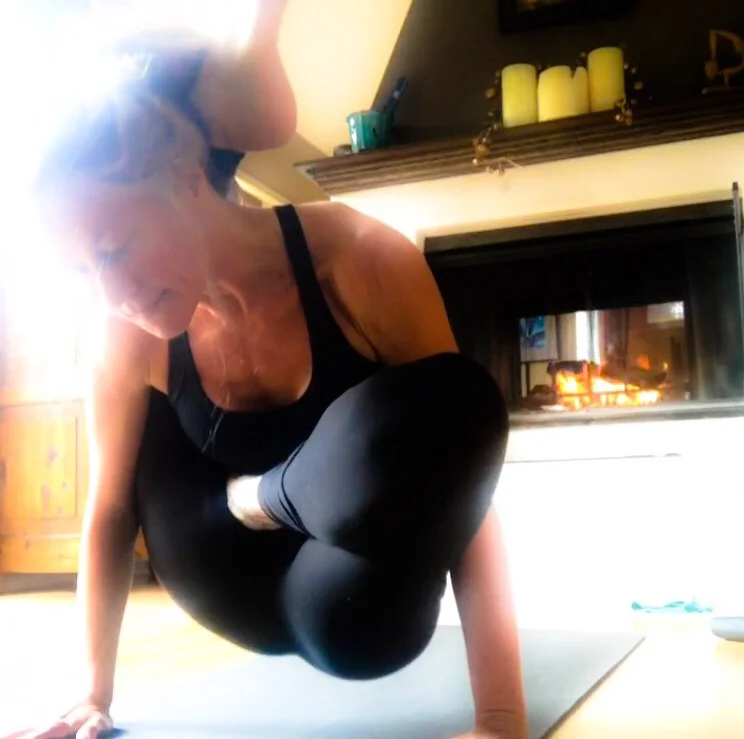
Yoga is not performance. Asanas are known to make your mind very stable, and that’s why I do them, along with the profound after effects and how these effects trickle into life as a whole.
Each person is different (mind, history, physical skeletal structure, lifestyle, heart and soul); I don't believe that there is just one way to do a yoga pose to be "correct". There is more to it.
on the other side of challenge
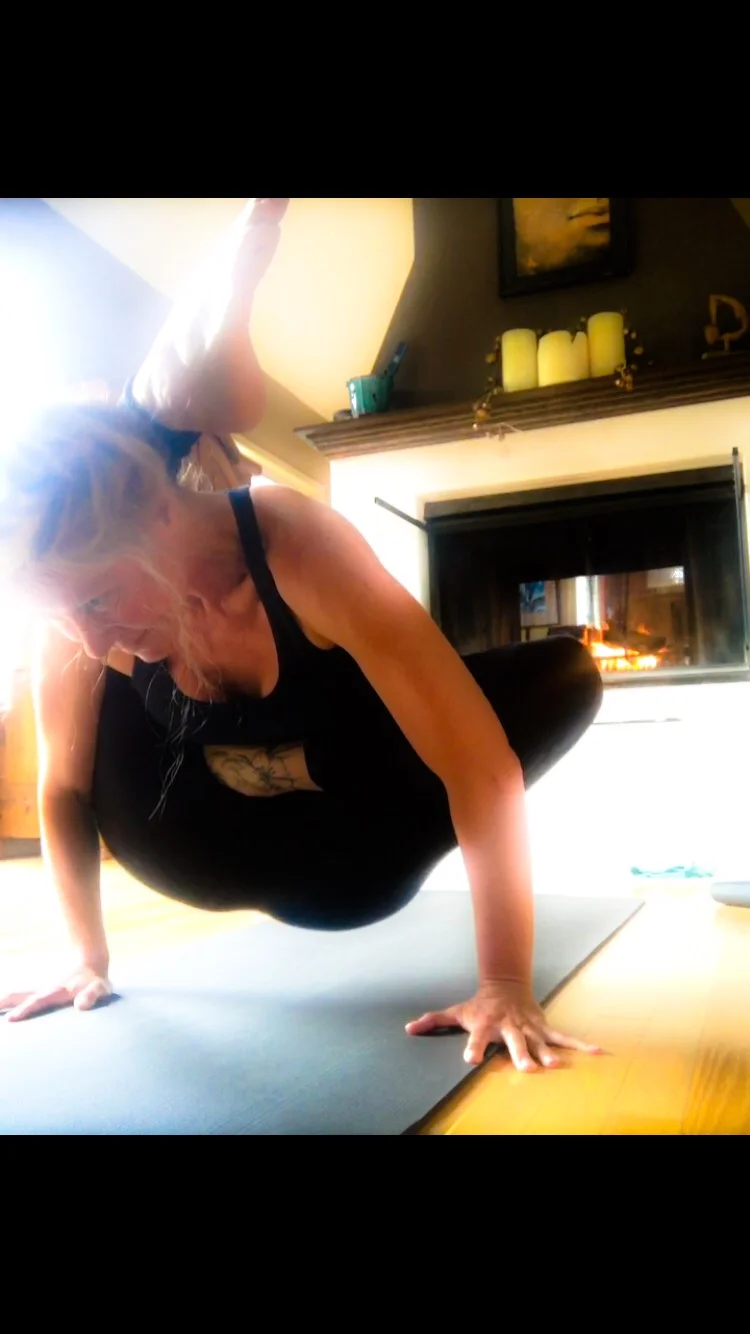
© image Robin Ellen Lucas
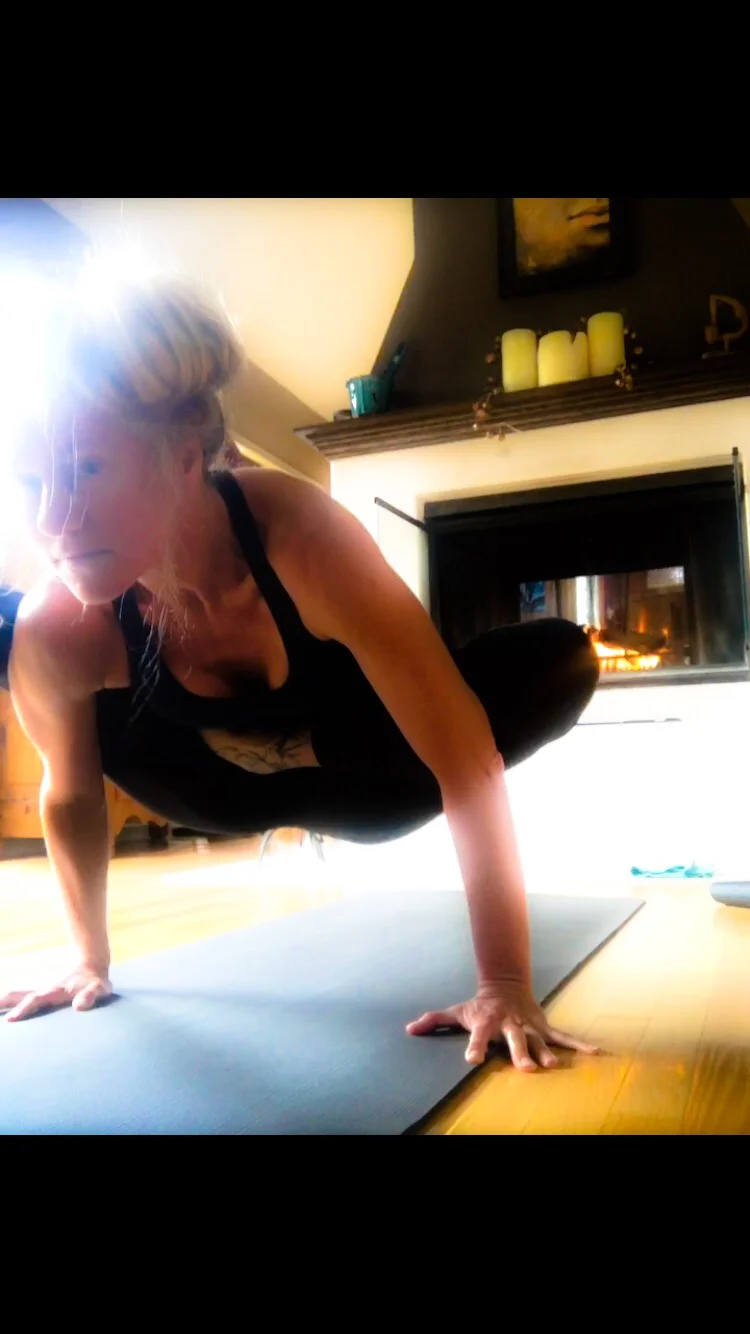
© image Robin Ellen Lucas
This pose, Viranchyasana A (the third part of it) in the Ashtanga 3rd series (Advanced A) has a lot more going on than performance in the moment. It's a challenge.
It's not that I enjoy struggle. For me it's what's hidden on the other side of challenge, and how that pursuit translates into life on many levels.
It's taken me over 20 years to have the flexibility and strength and trust to even try this asana, and mostly to get my mind out of the way.
look inside yourself
The benefits are in the nervous system, the somatic subtle body, the ego, emotions, hormones, etc. (I could keep adding to that list all day). I am looking inside my own self here, and it's a very calm and beautiful place.
Namaste.
~ Robin Ellen Lucas, MA
In my blood: Cardiovascular system, the heart and its many facets
 Koundinyasana B (Image © Robin Ellen Lucas)
In a song that keeps playing today, I hear my blood. It speaks of being inside my blood. From my yoga Healing Series on Cardiovascular System—combing through various anatomical systems, presenting the physiological, emotional, spiritual and yoga aspects—I am reminded that this was my favorite section. It was the last one; I saved the best for last, as the cliché goes.
It's all about the heart. Blood and plasma, protection from disease, effects of oxygenating the blood, emotional and subtle heart, unresolved traumas, yoga and the venous return to the heart, blood as a healing entity, blood circulation affecting the nervous system, traditional chinese medicine perspectives, somatic levels of changes, etc.
Back to the song:
"Every time I close my eyes I know that I'll wake up."
We know that we'll wake up again each morning because our blood is flowing.
"I don't know how it happened, but you got into my blood. And I feel like you're lifting me up. Was it real or did I just make it up?"
It's real.
Read more here -> /cardiovascular-system/
Namaste.
Robin Ellen Lucas, M.A.
Digestion and emotions: Which brain do you use?
 Galavasana (Image © Robin Ellen Lucas)Digestion and emotions are connected. The belly holds a lot of power. The power center is accessed by activating mula bandha and uddiyana bandha.
The vagus nerve connects digestive system / enteric nervous system in the gut to the central nervous system. Read more here about the digestive system and its anatomy. It's important to have optimal digestion to practice Ashtanga yoga, but also in life as its dysfunction can cause a ricochet effort on other anatomical systems and optimal subtle body health.
what you cannot see
Having said that, in this pose, Galavasana,
Galavasana (Image © Robin Ellen Lucas)Digestion and emotions are connected. The belly holds a lot of power. The power center is accessed by activating mula bandha and uddiyana bandha.
The vagus nerve connects digestive system / enteric nervous system in the gut to the central nervous system. Read more here about the digestive system and its anatomy. It's important to have optimal digestion to practice Ashtanga yoga, but also in life as its dysfunction can cause a ricochet effort on other anatomical systems and optimal subtle body health.
what you cannot see
Having said that, in this pose, Galavasana, I'm not just holding myself up with my abdominal muscles. First, of course, the bones are stacked correctly and arm and leg muscles activated. Most importantly here, however, is what you cannot see in the photo. I'm activating the bandhas (internal locks in pelvic region), my mind is clear, my body is well rested (I go to sleep by 9:00 p.m. each night), my diet is clean, I am an essential oils junkie advocate which is a lifestyle, et al.
It's what's inside me. There is a personal power activated within my mind having performed this pose each morning as part of my Ashtanga practice.
"mind is going"
One point that comes to mind is that I am often exhausted at this stage in my Ashtanga practice, yet the pose happens. It's a great example of my mind-body working from the subtle body to find energy, strength and memory. My teacher, Tim Miller, says to me "mind is going" in a humorous tone when I forget where I am a couple hours into my practice—guided from a spiritual place. Even so, my practice happens. It's on auto-pilot.
"Do your practice and all is coming," by Pattahbi Jois, is a phrase that sets Ashtanga yoga aside from other yoga styles. The body goes on auto-pilot and teaches its lessons from there. After the initial lesson(s) from the teacher, there is often no one to instruct or explain what to do, when, or how—only helpful adjustments in silence—which allows the dedicated practice to be the teacher.
your inner voice teaches
Ashtanga yoga is about listening to your inner voice. Over time, your practice is your teacher. I resonate with this on a subtle body level, having done led Iyengar and mixed-style/level Vinyasa classes for 18 years prior to trying Mysore-style Ashtanga yoga. My inner voice is the reason I have completely switched over. It gives me the chance to hear, to heal, to go to the next level (physically, emotionally, spiritually).
It reminds me to use my bandhas and take full breaths continuously because I know in my heart that my core/lower abdomen/pelvic region (from the inside to the outside) is my power source! This holds true for my entire life, not just yoga poses.
From my experience, teachers of led yoga classes often guide by requesting skeletal alignment and muscular engagement because that is what they can see in their students. They may cue the importance of using your bandhas and trusting in yourself, but in a sense, it's truly only part of their verbiage—despite their intellect and experience, not necessarily what you, the student, are going through in that very moment.
Ashtanga yoga reveals
I have some of the hidden answers in my body. They reveal themselves when I do the poses over and over and over, with patience and perseverance (and no attachment to the end results since each day can be different). For me, the blocks—physical, emotional, spiritual—are released in the subtle body. No teacher is telling me about that; I am.
It is my thought that restrictions by a teacher create rigidity in the students' minds and bodies, which is the opposite of the freedom we wish to create in our yoga practice.
That's a vague statement if you delve into it both intellectually or experientially within your own yoga practice. Sometimes, these notions can be referred to as coming from different parts of ourselves, as if we have more than one brain in our bodies. I understand this concept directly through my study of essential oils.
essential oils and different "brains"
There is, of course, a brain in your head and central nervous system. Frankincense essential oil activates the spiritual, supporting your ultimate brain functioning. It's known to oxygenate the Pituitary gland, which is the master gland that controls the release of hormones from other glands. It’s vital to our well-being and also connects to the Hypothalamus (nervous system), harmonizing them together. Yoga also accentuates this balance.
Along these lines, there is another "brain" in your gut and enteric nervous system / digestive system. Circling back to the initial point in this article—digestion and emotions—as I discussed in my Healing Series, there is a lot more going on in your belly than abdominal muscles. Our guts (literally) are in the area that has been medically proven to be a second brain, the enteric nervous system. Including neurons, neurotransmitters, hormones, your gut is able to learn, remember and produce emotion-based feelings. The two nervous systems are connected through the vagus nerve. (Source: from my Healing Series)
Fennel essential oil helps digestive functions act on their own, in particular ridding the body of the toxins that hold you back. It is also said to restore strength and courage, going back to ancient Egypt.
Finally, I can identify with another "brain" in the feet and sense of self. This is essentially in the first chakra in the subtle body but also the emotional body. Myrrh essential oil is an earthy essential oil which grounds the nervous system. The bottoms of the feet are an ideal place for the oil—like walking in the dirt or grass.
Tend to your digestion and emotions... For more of my writing on essential oils, go over to that blog.
Namaste.
~ Robin Ellen Lucas, M.A.
Are you nervous? Ashtanga yoga cleanses the nervous system
 Bow to who you are becoming... (Balasana, image © Yoga Robin®)Are you nervous? Many people do yoga to increase strength and flexibility, to lower stress and to gain mental and spiritual clarity. Those are great reasons. After a yoga practice, no matter which style (e.g., Ashtanga, Iyengar, etc.) you'll undoubtedly be left with an overall feeling of peacefulness that tops the way you felt before you moved your body.
uplift mood, lower stress
Physical exercise in general helps to uplift the mood and lower stress levels; in particular, it diminishes Cortisol, the stress hormone. Ashtanga yoga has an added benefit: nervous system cleansing.
This is especially true in the Ashtanga Intermediate Series, Nadi Shodhana (2nd series), and that is its main purpose. This goes back over 5,000 years. When practiced regularly (5-6 days per week), the "cleansing" of the nervous system can be felt in various ways and many are *not* enjoyable.
nervous system cleanse kicks your ass
It wasn't until after practicing Mysore-style Ashtanga six mornings per week (specifically, half of the Primary Series, full intermediate, and beginning of advance A—takes 2-2 1/2 hours) for approximately nine months that I was able to discuss the nervous system cleanse in a positive light. That is putting it lightly.
It can feel like overall fatigue. All. Day. Long. It can feel like anxiety, over-sensitivity to lights and sounds, depression, obsession, needs to be in solitude, drinking more wine, yet a pervading fearlessness that overrides it all... It can feel overly emotional. It can take over your life and force you to make some big lifestyle changes, like adding an afternoon nap, going to sleep earlier, eating more protein, taking more epsom baths, wondering what is wrong with your life, questioning love, feeling safest while hanging out with your cats, etc. But why do it if it causes so much upheaval to the system?
because it works
Because it works... I like to see the nervous system cleansing as I would any other type of cleanse where you're taking away habits that may be contributing to harm in your body. Whether this be detoxing from sugar, caffeine, or all food in general to clear out the intestines, a cleanse does not necessarily feel good while you're in the process of it. The idea is to rid your body of toxins; on their way out, you feel them full force as they rise to the surface, so to speak.
This is all a great way for me to understand the nervous system cleanses. I was feeling toxins in my nervous system and I was boldly letting them play themselves out, knowing that if they didn't, they would continue to control me from underneath it all. In this case, they were involuntary processes driving me, also affecting me physiologically, and were of a higher intelligence in the mind-body.
It all makes sense. The nervous system directs complex processes (seeing, hearing, tasting, feeling, responding). It regulates the internal environment and links to external environment. It directs the organs in the body so that they don’t act independently of each other; without a nervous system, there’d be chaos inside.
wants to feel that again
When the autonomic nervous system's sympathetic is out of balance, and escalated (fight-or-flight), your body reacts as if it needs to protect itself... your heart beats faster, your body temperature increases, you feel anxious, you feel like a victim, you are triggered by even small incidences (as your nervous system remembers and wants to feel *that* again).
I describe this as an electric feeling that will *not* go away no matter what I do to try to soothe it. It was probably even accompanied by a scared look on my face—or in my aura—that even animals would stay away from me.
Calming this side down illuminates the parasympathetic, bringing calm to your body, heart and soul. Here you can breathe calmly again and the electrical impulses are replaced with a softly-flowing river of prana, bathing you with each breath. Your muscles relax, your mind stops overthinking, you actually are relaxed.
I believe that the nervous system is smarter than the mind. Yet, its direct connection to the mind dissolves the protective boundary as it's easily triggered, vulnerable to the mind's overthinking and worry. A main purpose of yoga in general is complete cessation of the mind, as the thinking mind is what creates suffering.
i've been rewired
I'm different now. Subtleties such as no longer becoming easily startled by spontaneous sounds make me smile when I notice this new involuntary response of calm. The biggest change is an overall lack of emotional triggers that have historically affected me deeply, physically but also unconsciously; those natural responses—harmful ones—have dissolved. That's my reason in a nutshell for waking up each morning at 5:00 a.m. to return again to my mat.
Now I'm able to go to the next level, which used to be more of an act of will power or something that only worked for other people. The best way to feel your spirit and know—without a doubt—your next move in life is to first get STILL. This means, calming the nervous system first so that you can see the magic. Ashtanga Yoga works for me and essential oils are a big help too (next topic :)
Namaste.
~ Robin Ellen Lucas, MA
Find your strength by uncovering fear
 Galavasana (Image © Yoga Robin®)When you're trying to find the strength, sometimes it can be found in what would seem to be indirect places.
Expressing emotions unlocks secrets. Voices speak from within the subtle body. What you hear might not be easy to deal with, but move your body around anyway and hear it. Unclog your heart.
Don't build a shell around you or act out from that hidden source covered with fear. Embrace uncertainty.
Namaste.
~ Robin Ellen Lucas, MA
Backbends are a sure thing for unleashing prana
 Natarajasana B (Image © Yoga Robin®)This pose feels so good with the strap. The Ashtanga way is to hold the toes, no strap (and for me, this means that all of my energy goes toward not dropping the foot, or even getting it). My favorite Iyengar teacher instructs this one with a strap.
It is a wonderful shoulder opener (euphoric) and doing it this way I'm feeling the Prana in my shoulders, entire back, up and down legs. I'm even smiling. Using resistance against the strap (foot and shoulders higher up) feels even better. I forget I'm even balancing. My favorite backbend...
Backbends are a sure thing for unleashing all kinds of emotional holding. For me, it's a guarantee and always leaves me happier. Some people experience fear and sadness in backbends (and I'm also one of them) as these feelings hide inside a broken heart or cold heart that doesn't feel much...but can't help but rise to the surface in backbends. Getting the energy to express itself is a wonderful way to release it.
Namaste.
 Eka Pada Rajakapotasana (Image © Yoga Robin®)
Cardiovascular System, Blood
 Healing the Total Body: Where Western Anatomy Meets Eastern Spiritual Science
Healing Series, part 10
Read on for more details...
Digestive System, nutrition and metabolism
 Healing the Total Body: Where Western Anatomy Meets Eastern Spiritual Science
Healing Series, part 9
Read on for more details...
Nervous System, Focus, Acupuncture, and Herbs
 Healing the Total Body: Where Western Anatomy Meets Eastern Spiritual Science
Healing Series, part 8
Read on for more details...
Muscular System and Love
Healing the Total Body: Where Western Anatomy Meets Eastern Spiritual Science
Healing Series, part 3
Listen to your heart
Where am I? I sometimes wonder. My heart is the biggest part of my yoga practice. It’s the biggest part of my life, in fact. My physical anatomical heart is affected too. My heightened emotional state increases my heart rate. My yoga helps me reframe my love for myself and others, reversing bad mental, emotional and spiritual habits.
Voices in the subtle body
By moving the secrets I hide in body parts, voices arise spoken through my subtle body. What I hear is not always easy to deal with. I do yoga anyway because I know it’s my path. Whatever I do to open my heart, allowing my heart’s wisdom to speak, is helpful for me.
When it gets too hard and I close up, what stops me from wanting to connect with my heart? I know that to feel the wounds is to release them. Carl G. Jung describes that the,
“Dark night of the Soul sounds like a threatening and much to be avoided experience. There is no coming to consciousness without pain. People will do anything, no matter how absurd, to avoid facing their own soul. One becomes enlightened by making the darkness conscious.”
Creative heart is not a guilty pleasure
Dreams and visualizations come from the open heart space, not a closed place of resistance and internal rebellion. My creative heart is not a guilty pleasure; it is the answer.
The chakra system describes my subtle body: Shoulders are the 4th chakra (Heart Chakra of love), the hips are the 2nd chakra (Sacral Chakra of creativity). My practice is my teacher.
Emotions unlock secrets
Where emotional patterns turn to physical pain and then leave (samskaras burning), I am harnessing this heart pain too—the door to healing. To sit dormant with the anger is only "acting out." Sometimes I keep my composure during my practice and other times I'm emotionally and physically weak.
"Anger is the deepest form of care for another... Stripped of physical imprisonment, anger points toward the purest form of compassion, always illuminates what we belong to, what we wish to protect, and what we are willing to hazard ourselves for." ~David Whyte,
Fearlessly release secrets
This all happens spontaneously because I fearlessly move the body parts that protect my secret, and my breathing circulates it all. Toxins are included with spiritual truths, and they all voice themselves inside me until I break apart. The voice given in this spiritual place I go to is the truth.
When I really feel my emotional heart, my Nervous System relaxes, my subtle body energetically softens and the door to bring love to me opens. Whereas in my “escape”, (fantasy, snide humor, psychological analysis, etc.), I am in denial. Why escape?
Embrace uncertainty
Sometimes paying too much attention to balancing the emotional heart by soothing discomfort should instead be felt as raw emotion for a release. Paying better attention to what the discomfort is saying allows me to learn the important messages about letting go.
Muscle fatigue
With all of this yoga and attention to the emotional heart, next comes muscular pain. It’s an indication of muscle-building, comes up in the form of fatigue, and occurs where we need it most sometimes. I invite the Muscular System into my focus, mainly the voluntary muscles—the ones which contract when stimulated by neurons when I consciously use them to move my leg, arm, etc. and relax by being passive; they are known as the skeletal muscles. I’m also working my involuntary muscles—the ones which work in the walls of the intestines, blood vessels, heart (but I’ll get into this later).
Muscles inflamed with repetition
When I learn a new yoga pose and repeat it daily, this new repetition of certain skeletal muscles are in pain, tightened, and in great need of care. I get monthly deep tissue massages to stabilize the muscle tissue structure—muscle cells separated and wrapped in layers of connective tissue, enclosed in fascia, connected to the bones with tendons.
Muscles contract when I use them, but my feat is to relax them completely after using them so that their contracted state doesn’t build up creating a knot, and touching nerves that trigger unnecessary (and imbalanced) compensations with other muscles. Much of this is reversed and calmed into a stable state after massage.
Fatigued muscles lack oxygen
Why does muscle-building cause fatigue? Healthy muscles (called "red muscles”) have a reserve oxygen supply, permitting them to contract and relax repeatedly while maintaining cellular respiration which resists muscle fatigue. The myosin protein in muscles causes contraction and relaxation acting as enzymes, which break down ATP molecules (adenosine triphosphate). ATP provides energy so we want to keep an ample supply in our muscles. When ATP is used up too quickly without the oxygen to support it, muscles (called "white muscles") become quickly fatigued with the build-up of lactic acid—an indication that muscle cell oxygen has been depleted.
Lactic acid build-up not only causes discomfort but also is delivered to the liver (and too much on this organ causes the Digestive System to overwork). Therefore, I want more red muscles and enough ATP to not only contract muscles but also relax them.
Drinking water flushes lactic acid and toxins
Sometimes I'm told that the TCM pressure points (Traditional Chinese Medicine) on outer top of my feet are sensitive and painful. This points to liver aggravation (eating oily food and extra lactic acid build-up). Drinking a lot of water dilutes this. Drinking water is not good to do before morning Ashtanga yoga, as it makes me spiritually heavier. But drinking water during the day, especially with muscle pain, flushes out the toxins which creates relief; it's become my post-yoga activity.
When I'm most sore, I soak in an Epsom salt bath. Why does this soothe muscle soreness? The magnesium in epsom salts—absorbed through the skin—helps relax skeletal muscles by flushing lactic acid build-up in the muscles. Magnesium is an abundant mineral in our bodies and its role in our overall health is important. It can be found in over 300 different enzymes in our body and is vital for activating muscles and nerves, reating energy in the body and efficiently digesting proteins, carbohydrates and fats. Other ways to replenish magnesium are eating organic foods, lowering sugar intake and lowering stress.

Start here, self that hides: A vision into the yoga self
 i write whatever you say to meMy yoga stirs up emotions in me and sometimes speaks as pasts and present all intermingle. As my body moves, and as I breathe, my stories are told. Here is a conversation with karmas that were burned one morning.
vision of yoga self
Dear self who hides,
I don’t want to leave you, or myself, behind. When your words are near (and I hear you speaking through me), I cannot help but smile inside. When I am my body, standing in front of myself, sometimes my heart shuts down. Why? I feel you more after I leave you, as if a piece of me is still with you. And so it is; you are me, left floating through the yoga studio room, melting onto the floor.
i write whatever you say to meMy yoga stirs up emotions in me and sometimes speaks as pasts and present all intermingle. As my body moves, and as I breathe, my stories are told. Here is a conversation with karmas that were burned one morning.
vision of yoga self
Dear self who hides,
I don’t want to leave you, or myself, behind. When your words are near (and I hear you speaking through me), I cannot help but smile inside. When I am my body, standing in front of myself, sometimes my heart shuts down. Why? I feel you more after I leave you, as if a piece of me is still with you. And so it is; you are me, left floating through the yoga studio room, melting onto the floor.
I leave pieces of me for you to care about, given freely. While I'm there, hold me, I ask you, because I can’t hold myself in this way. Why would I want to take the place of you (and your arms I imagine) around me, pieces of us touching, filling gaps sensing all at once? How could I ever be without you after having you? You come to me in my dream, my seed (you are), and I’m special.
self-love
How I could not have that, I do not know. I have you any time I want, for me to enjoy fully. I just don't know it. But now, I cannot ask or show you this. I can only sit, wait and cringe over my missed opportunity. My closed heart—again, protecting itself, ego on guard standing tall against its tears. When your presence is in the forefront of my mind, I want for you to be the one to say what I dream, as if I transfer my dream to you, and now it’s heard. Instead, I walk away, and so do you, words uttered yet unheard. Too vulnerable to ask simple questions.
And next, I hear you tell me (in my mind), “Don’t you understand how much I want you?” (but it seems like a dream.) If we have to start somewhere, let’s start here.
Original version published on Rebelle Society
© 2014 Yoga Robin®
Surrender to your heart: Let go of anger, sadness and stories that cover up your love
 find your peace
Maybe it doesn't seem like it at times, but there is peace within you. Sometimes it's hiding on purpose, so that you cannot find it easily. Let's say you find the source of a problem and throw it out the window. But your inner chaos returns. Why?
Surrendering is a process. You need to believe that it relieves you. And then know that this action needs to be repeated.
But what does surrender even mean?
find your peace
Maybe it doesn't seem like it at times, but there is peace within you. Sometimes it's hiding on purpose, so that you cannot find it easily. Let's say you find the source of a problem and throw it out the window. But your inner chaos returns. Why?
Surrendering is a process. You need to believe that it relieves you. And then know that this action needs to be repeated.
But what does surrender even mean? Holding up a white flag? No, it happens when you emotionally give in to life's predicaments. Surrendering to your heart will silence your anger, maybe cause some teardrops, but definitely release stress.
Its other name is freedom.
forgive, write, move, clear
Forgive yourself. Stop your thoughts that spin out of control. Write a letter to your anger and then burn it, or send it to a friend so together you can laugh. Move your body—yoga with attention to breath is best—and clear the blocked energy. Don't forget to keep breathing. Close your eyes. Express yourself.
Transform unmet desires to find the true power fueling them. Drop down to the ground and bow for strength if you must (Child's Pose is a perfect yoga pose for this). Don't fear.
lessons hidden in chaos
You cannot ignore that you are human, and you have a heart, mind and emotions which speak. Sometimes loudly. Acknowledge it, be gentle and always find the blessings. There is much to be learned from chaos anyway, as what's really trying to get your attention rises its head, juxtaposed against the rest.
If by chance you have never felt the bliss of stillness, then it should be your next goal in life. Once you feel it,you won't go back!
If you leave a yoga class, for instance, before savasana repeatedly because
1) you're in a hurry
2) you feel your to-do list brain kick in
3) you are bored
4) you are too stressed to be still
...you are missing the best part. The part you are missing is the silent clarity. Even 2 minutes can fuel your whole day.
Surrender to being you.
 Model: Cora Varnes 2009, Location: Maui
Namaste.
© 2014 Yoga Robin®
Nurturing your body by taking it easy in yoga vs. being lazy: How do you know the difference?
Is your yoga sometimes an escape? Do you go to class when you are feeling bored or escaping life, and therefore give life its purpose through your yoga practice? It doesn't matter if it's hardcore or not.
take it easy some days
It's not necessary to expend a 100% effort during every yoga practice. Some days your body needs more tender loving care, and it's better that you show up on your mat than not at all. These can be the most transformative days that rewire your brain, in fact—the days when you are not motivated to go to class and you go anyway.
practice relaxation in life
These chances on your mat could also be practice for emulating a more relaxed way of being in life, feeling pose by pose that you may be better off (even more productive) to go slower. You may realize here that the key to ideas, creativity and life unfolds naturally, and does not respond to pushing.
are you being lazy?
But if you take the easy way often (just because you did it last time and the time before), are you training yourself to be lazy when you are potentially on your way to your physical best where you are capable of breaking through to a new level? If you let laziness get the best of you, you hold yourself back from the mind and body's largest lessons. You also set yourself up for laziness once you return home, from work to household chores.
live with elegance
On the flip side, if you push to the max in every class, competing with yourself every day, this mentality makes it into your life—where it's important to live a balance between effort and elegance.
I flip back and forth between the two, trying to be real with my reasoning. When I notice a bad pattern, I question it, realize it, and then try to bring it into my conscious brain during my next yoga class. I have been going to early morning yoga almost every morning for 6 weeks now, and sometimes doubling up with evening classes too. In this space I have created for myself—sort of a mini yoga retreat—I don't give myself the chance to slack off. Even if my practice is mellow that day, my mind is alive and awake, evolving.
I am carving through what holds me back in life:
- boredom
- impatience
- overthinking
- anger
- negativity
- escape
- physical weakness
- physical injury
- sleepiness
- time
- mothering worries
- too many words
- not enough words
- wrong choice of words
- lack of motivation
- self-critique
- etc.
intuition
I am looking each in the eye (with my third eye) and showing it "I'm on to you." In doing so, I'm becoming bolder and more attuned to true content and happiness. My intuition has now taken over. Try it...
© 2013 Yoga Robin®
What happens after yoga class: Where do the toxins and emotions go?
 capture who you are
After yoga?
What do you do after yoga class? You went, you opened, twisted, sweat and stretched it all out. You unleashed emotions and thoughts, and sealed it all in with intention in the end (savasana).
Do you then just go on with your day?
Yoga—if done mindfully—can create euphoria and bring you to your happiest self. It can also bring you to the opposite as it acts as a sort of catalyst to making you face your darkness, as all that you hold inside your tightest body parts rises to the surface and begs for your attention.
Yoga opens you
This happens without notice with yoga poses that open the hips and shoulders, abdominal twists and mainly yoga breathing (i.e., ujjayi pranayama). With yoga, you are not only wringing out toxins, but also releasing emotions and setting energy free...
Be with what you find
Whether magical or disturbing, you can capture the essense of all that comes up in your yoga class by working with it. You can write it down (to share or not),
capture who you are
After yoga?
What do you do after yoga class? You went, you opened, twisted, sweat and stretched it all out. You unleashed emotions and thoughts, and sealed it all in with intention in the end (savasana).
Do you then just go on with your day?
Yoga—if done mindfully—can create euphoria and bring you to your happiest self. It can also bring you to the opposite as it acts as a sort of catalyst to making you face your darkness, as all that you hold inside your tightest body parts rises to the surface and begs for your attention.
Yoga opens you
This happens without notice with yoga poses that open the hips and shoulders, abdominal twists and mainly yoga breathing (i.e., ujjayi pranayama). With yoga, you are not only wringing out toxins, but also releasing emotions and setting energy free...
Be with what you find
Whether magical or disturbing, you can capture the essense of all that comes up in your yoga class by working with it. You can write it down (to share or not), talk about it, drink green juice to rejuvenate the missing gaps or simply be with "it" and acknowledge it. It calms your nervous system to take your yoga to the next level by realizing all that you become afterward. [The photo above has special meaning to me, each leaf.]
Your yoga practice is a direct reflection of your life. The way you handle a challenging yoga pose that stresses your muscles, your ego, or touches an injury, is the way you handle challenges that come up in life. For this reason, if you watch your mind during the difficult postures, and breathe into it and treat yourself with patience, you can train yourself for life's difficulties, confrontations, hindrances, sadness-provoking situations and toxic people.
Don't leave before savasana!
Some people leave class *before* savasana. I don't understand this. It's the grand finale and place to really capture the reason you are there in the first place.
Each has his/her own reason for leaving early sometimes, whether it be to pick up a child (and it's better to go to yoga partialy than not at all) or feeling sick, for instance. However, there are many other reasons people leave early, and their departure before the mental or physical challenge only causes them to lose out on lessons:
1. Fatigue
2. Dislike the music or heat or neighbor
3. Stillness at the end too quiet
4. Boredom
5. Challenge
6. Sadness
Regardless of the six reason above, these are great chances to practice withstanding fatique in any life situation, seeing the goodness in others, losing denial and feeling truth, focusing on intention building and going inside, breathing into physical challenge and transforming strong emotions into personal power.
Keep your clarity
Remembering that yoga is not just exercise is to be on your way to knowing that your class is only the first step; it's an opening that leads you to the avenue to your dreams. It brings you more clarity and leaves you with the feeling that you just did something awesome for yourself.
Be introspective. Take your yoga to the next level and find the answers you hold (even from yourself). Be you, creative™.
© 2013 Yoga Robin®
Don't give away your personal power by complaining
Be empowered when you are injured or in pain. You have what you need inside to heal yourself if you let your body's inherent wisdom do its job.
keep your power
Are you ever around people who complain, sometimes incessantly? Do you ask yourself if they are actually expecting you to take care of their issues?
 own your own issues, feel your heatWhen you complain, you are giving away the answers and natural healing abilities. When others are in the room to hear you—whether intentionally or not, you put it out there for the person who is potentially listening. Do you think that person should heal you?
no whining
If not, then why
Be empowered when you are injured or in pain. You have what you need inside to heal yourself if you let your body's inherent wisdom do its job.
keep your power
Are you ever around people who complain, sometimes incessantly? Do you ask yourself if they are actually expecting you to take care of their issues?
own your own issues, feel your heatWhen you complain, you are giving away the answers and natural healing abilities. When others are in the room to hear you—whether intentionally or not, you put it out there for the person who is potentially listening. Do you think that person should heal you?
no whining
If not, then why do you moan in their presence? Most importantly, why do you give away your personal power?
Keep it for yourself. Your words are only annoying or unheard (if the person in the room is skilled enough to fend off your negativity). You may get the attention of an unsuspecting worrier or healer, but truly you are your own healer. Searching for sympathy won't heal you.
Love will. Love yourself. Listen to yourself.
© 2013 Yoga Robin®
Are you more right-brained or left-brained while you practice yoga?
Right-brain? Left-brain?
Do you associate more with the right side of your brain while you practice yoga or the left side of your brain?
 The two hemispheres of the brain have fascinating connections (Photo credits: Simeon Schatz)
Creative vs. logical
The right-brain/left-brain theory grew out of the work of Roger W. Sperry in the late 1960s, who was awarded the Nobel Prize in 1981. The cerebral cortex controls rational functions and is made up of two halves, connected by masses of nerve fibers which pass messages between each other. These halves, or hemispheres, are commonly referred to as right-brain and left-brain.
Right-brain? Left-brain?
Do you associate more with the right side of your brain while you practice yoga or the left side of your brain?
The two hemispheres of the brain have fascinating connections (Photo credits: Simeon Schatz)
Creative vs. logical
The right-brain/left-brain theory grew out of the work of Roger W. Sperry in the late 1960s, who was awarded the Nobel Prize in 1981. The cerebral cortex controls rational functions and is made up of two halves, connected by masses of nerve fibers which pass messages between each other. These halves, or hemispheres, are commonly referred to as right-brain and left-brain.
The right-brain is best at expressive and creative tasks. Characteristics associated with the right-brain include emotions, music, color, intuition and creativity. The left-brain is considered to be adept at tasks that involve logic, language and analytical thinking.
People are said to prefer one type of thinking over the other. Each of us has the propensity to have a mix between the two, but be more predominant with the left or right side of the brain with certain activities.
Yoga brain
In my opinion, the poses and teachings of yoga allow me to subdue my left-brain, bringing it under control with the training and discipline inherent in yoga. This illuminates my right-brain in ways that seem mind-blowing...
Jill Bolte Taylor, a Harvard Brain scientist, shares this theory. She had a life-changing experience when a stroke in her left-brain shut down most of its functioning, thereby illuminating her right-brain activity and control. She tells her story with hopes to promote peace for those who can utilize ways to allow the euphoria she experienced. So, if we take her stroke of insight and apply it to yoga, we can deduce that the disconnect between euphoric states and reality can be explained by the relationship between the left-brain and right-brain.
In other words, that which divides us is simply the mind...
Looking at the connections between psychological processing and yogic, spiritual experiences, it seems true that in everyday life we have a tendency to let our psychological ego (primarily left-brain) take over our identity in the world. Mindless chatter and formulations of who we are in the world keep us on the ground.
In contrast, a spiritual experience moves us to another realm where time and space do not appear to exist. This focus connects us to the right-brain, disconnected from brain chatter. In the pure right-brain there is peace and a new definition of reality. In these experiences, we may not know (or care) where our bodies and minds begin and where we end. Without all of the stresses of the real world (no left-brain activity), bliss takes over. It's pure submission of the left-brain to the right-brain.
In terms of Sankhya-Yoga, by calming the rajas and tamas I can leave the excessive chattiness or sluggishness of the left-brain to rest. My goal in yoga—samedi—is absent of all detailed left-brain thought when it's dialed in to the spaciousness and spirit that emerges, indicative of the right-brain.
Artistic brain
Let's take another activity to compare. When I start a painting, I first need be able to to visualize the final painting in my mind (right-brain activity), and then develop the painting by doing various tasks simultaneously such as choosing the elements, matching and mixing colors, and placing shadows and highlights (more right-brain). But, at the same time I must be able to look critically at what I'm doing (left-brain activity).
So, our creative juices (right-brain) formulate inventive way to display our dreams in our minds. Yet, when methodically creating structure, edges or following an instruction of some sort, the left-brain kicks in.
Physical activity brain
With a sport such as running, the goal-driven act to go a certain distance and route is left-brained. Allowing adrenalin to become spiritual to take us higher and away from it all is the right-brain in full swing.
Back to yoga and the physical aspects. Using the same philosophy, a rigid routine such as Bikram or Ashtanga Primary Series would fall into the methodical left-brained realm, whereas self-led Vinyasa Flow guided in a moment by the soul or music is right-brained. Yet, with a dedicated yoga practice, before beginning we see the whole first (right-brain) and then let the details take us there. And, Vinyasa Flow can have the propensity to start out without a vision, letting details take us (left-brain).
Spiritual brain, living yoga
I, myself, during my peak moments in life find that what may appear as fear in chaos comes together within me as peaceful when I realize the intricate balances in life. The truth that it all matters—chaos and explanation—thereby points out that to live yoga in everyday life is to balance out the right-brain and left-brain activity. The best place to figure it all out is in my yoga practice.
What has your experience been?
© 2012 Yoga Robin®
The medicine of yoga and herbs
Energy or emotional boost
While hatha yoga stretches out your body, lubricates the joints, pumps blood and healthy fluids through your body while also reducing inflammation, what can you do—outside of yoga—to aid the process? When you could use an energy or emotional boost, a cool-down, or even stress management, how can you gain some holistic assistance?
Herbs.
Why do many people not use natural remedies?
First, ask yourself why so many people take prescription or over-the-counter drugs when there are natural remedies that work with their body's natural chemistry and innate desire to be in optimal balance.
Herbs can kill viruses, headaches and pains
Herbs, in fact, can kill a virus, headache, or gastrointestinal stomach ache, and more. Aiding the immune system will not only help with long term health, but boost your daily mood and energy level.
MindBodyGreen.com highlights some interesting healing facts about the following herbs:
Astragalus helps to adapt the mind and body to a new environment, experience or discipline. This herb is an energy tonic good for the immune, digestive, and respiratory systems. It fights chronic fatigue brought on by stress, whether from a strenuous yoga class or life in general.
Cayenne is a pain-killer, anti-inflammatory and pain receptor-blocker, and can be applied in cream-form externally or taken internally. It is beneficial after a challenging workout. It's also stop hemorrhaging so is great for treating traumas of a physical nature.
Dandelion assists the liver in ridding the body of toxins that are released during an incredibly detoxifying yoga class. Toxins should not remain in the body (which lead to feeling tired or grumpy). While the toxins swim through your system, the liver dumps the waste into the blood and awaits the lymphatic system to flush it all out. This herb assists the liver to metabolize the toxins quicker so that you feel better sooner.
Evening Primrose helps to soothe overworked muscles and joints by providing the essential fatty acid which calms inflammation.
Ginger positively effects muscle fatigue and pain by lessening the inflammation—essentially alleviating pain. Its added benefit is that of increasing flexibility in the body.
Schisandra aids stress management by toning and strengthening the endocrine system and soothing the adrenal glands—activated when you are stressed. This herb works to repair the adrenal system, which results in a calm, healthier attitude.
Tumeric protects the liver from toxic chemicals. It has even been known to reduce cancer-causing agents in the body.
Namaste.
© 2012 Yoga Robin®
Find the right work-life balance: The key to happiness, health, well-being
Do you balance your life?
Are you a workaholic? Do you work extra hours because you really need the money, or do you believe your job really needs you, and that it's ok to take care of your job more than yourself? Or do you, for one reason or another, find yourself addicted to your computer whether it's work or personal?
Staying busy all the time does not help you
You do know that if you are working too much, you are acting like you are not very important.
Maybe, without knowing it, you are covering up something basic in your existence and doing it through your work. Staying busy all the time with a task that does not cultivate your soul can be like a drug that you continually allow to drive you. But you can beat it if you recognize who you truly are.
Nurture yourself
If you need rationale outside of yourself in order to ease up on workaholism, remember that no one really gets the best of you if you don't nurture yourself first.
Do you balance your life?
Are you a workaholic? Do you work extra hours because you really need the money, or do you believe your job really needs you, and that it's ok to take care of your job more than yourself? Or do you, for one reason or another, find yourself addicted to your computer whether it's work or personal?
Staying busy all the time does not help you
You do know that if you are working too much, you are acting like you are not very important.
Maybe, without knowing it, you are covering up something basic in your existence and doing it through your work. Staying busy all the time with a task that does not cultivate who you are can be like a drug that you continually allow to drive you. But you can beat it if you recognize who you truly are.
Nurture yourself
If you need rationale outside of yourself in order to ease up on workaholism, remember that no one really gets the best of you if you don't nurture yourself first.
Balance.
Work a bit / play a bit, be with people / be alone, talk out loud / think silently, analytical / poetic, yin / yang.
Exercise.
Move your body to move your mind too as your cells flow through you to renew you. Stagnant or blocked energy can push through to expression. Allow your life force to regenerate and free you.
Eating habits.
Nutritional value of the food you consume, as well as the timing, fuel the kind of person you become. Drinking pure water often during the day is a tremendous boost. If you let blood sugar levels drop, or if you allow head rushes from too much stress get the best of you, you are harming yourself. Pay attention to the calories you intake, making sure they will get you through the day before it's too late. If you are not on top of this, unhealthy cravings appear along with routines to lead you down the wrong path.
Silence.
Be honest and recognize if you are able to sit alone with yourself, hearing nothing but your own thoughts and be content. Can you just sit there alone, and eventually calm your thoughts? Learning to embrace silence is just as important as any other nurturing activity in your life. Set aside time in each day to do nothing but be silent and go inside yourself. Listen to yourself so that you can learn your magic that only you have the power to set free.
Social life.
Get out of your normal working routine and mix it up with friends to balance out your life. Better yet, do not even mention your work when you are socializing.
Emotions.
Take time to express emotions that come to you, whether they be desire, happiness or anger. Blow off steam with a healthy breathing routine, or run around the block. This can help you tremendously with anger management. Call a friend and have a good cry to release your spirit. Write a something creative, watch a sunset, or vacuum. Whatever it takes, whenever emotions arise... It's important to express in a healthy way.
Be easy on yourself. Break rules sometimes.
Rules are meant to be broken, especially if you are used to following them. This holds true for your mind too. You don't have to be the perfect meditator, perfect parent, perfect yogi, or perfect anything. This article, in fact, about living a good life, can be relaxed. Have some vices or most importantly give yourself a break in order to meet the best balance!
Ommm
© 2010 Yoga Robin®
Coming into wholeness
coming into wholeness
Coming into wholeness. Feel your peace. Be in love with your path in life.

Find it inside you. Let go of all that makes you worry. Be free.
Access this freedom any time! The truest side of you coexists with the emotional mind...
an advaita vedanta metaphor
Imagine 3 buckets of water.
The sun is shining in all three, and they each enjoy the sun equally. One is muddy, one is stirred up, one is still and clear.
Reflection in bucket #1 is dim and dull, in bucket #2 is agitated, and in bucket #3 is peaceful.
Sun is the Self, water is the Mind, reflection is the Ego (mis-identification)
Some conclusions...
coming into wholeness
Coming into wholeness. Feel your peace. Be in love with your path in life.
Find it inside you. Let go of all that makes you worry. Be free.
Access this freedom any time! The truest side of you coexists with the emotional mind...
an advaita vedanta metaphor
Imagine 3 buckets of water.
The sun is shining in all three, and they each enjoy the sun equally. One is muddy, one is stirred up, one is still and clear.
Reflection in bucket #1 is dim and dull, in bucket #2 is agitated, and in bucket #3 is peaceful.
Sun is the Self, water is the Mind, reflection is the Ego (mis-identification)
Some conclusions...
Your true self is a constant that is independent of how your mind is acting. If you appear to reflect "muddy water" you see dullness and depression. If you appear to reflect agitation, you will feel like you're breaking apart in pieces. If you appear to reflect stillness and clarity, however, you will feel a profound peacefulness with your Self.
So, if you're seeing muddy water, or water that is stirred up, how do you calm it? The answer is to calm the rajas (activity, motion and irritation in the mind) and the tamas (inert and dullness in the mind), so that you can feel the sattva (the purity of the mind).
rajas and tamas
Rajas and tamas create imbalance. Yoga, meditation or other physical activity & mental-calming activities will do the trick.
Independent of what is reflected by the mind, the sun is always shining and you are always whole. You just have to know it, feel it and identify with it.
Inspired by the teachings of Advaita Vedanta, Sankhya-Yoga and the Upanishads...
© 2010 Yoga Robin®